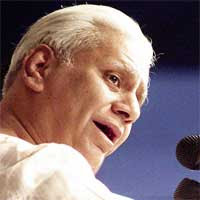
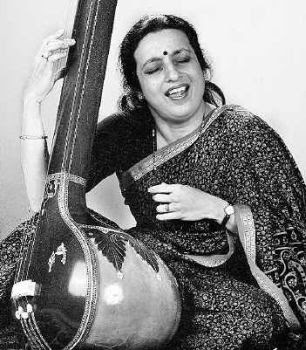
Kesarbai Kerkar ( कॆसरबाई कॆरकर) (July 13, 1892 – September 16, 1977) was an Indian classical vocalist of the Jaipur-Atrauli gharana.She is considered one of the finest and most powerful Indian classical singers of the 20th century
Early life
Born in the tiny village of Keri (also spelled "Querim"), in the Ponda taluka of North Goa, Goa (then a Portuguese colony), at the age of eight Kerkar moved to Kolhapur where she studied for eight months with Abdul Karim Khan. Upon her return to Goa, she studied with the vocalist Ramkrishnabuwa Vaze (1871 -1945). At the age of 16 she migrated to Mumbai, where she studied with various teachers, eventually ending up as disciple to Ustad Alladiya Khan (1855–1946), the founder of the Jaipur-Atrauli gharana, beginning in 1921. She belongs to Gomantak Maratha Samaj.
Career
Kerkar eventually achieved wide renown, performing regularly for aristocratic audiences. She was very particular about the representation of her work and consequently made only a few 78 rpm recordings, for the HMV and Broadcast labels.
Kerkar was awarded the decoration of Padma Bhushan by the government of India in 1969, and in the same year the government of the Indian state of Maharashtra conferred upon her the title of "Rajya Gayika." Indian Nobel laureate Rabindranath Tagore (1861–1941) is said to have been very fond of Kerkar's singing. Her honorific title "Surashri" (or "Surshri") literally means "excellent voice" (sur meaning "voice" and shri meaning "excellent), and was bestowed on her in 1948 by the Sangeet Pravin Sangitanuragi Sajjan Saman Samiti of Calcutta. In her ancestral village of Keri, the Surashree Kesarbai Kerkar High School now occupies the site of Kerkar's former second home, and the house where she was born still stands, less than one kilometer away. A music festival called the Surashree Kesarbai Kerkar Smriti Sangeet Samaroha is held in Goa each November and a music scholarship in her name is awarded annually to a University of Mumbai student.
Kerkar has the further distinction of having one of her recordings, "Jaat Kahan Ho", duration 3:30 (an interpretation of raga Bhairavi) included on the Voyager Golden Record, a gold-plated copper disc containing music selections from around the world, which was sent into space aboard the Voyager 1 and 2 spacecrafts in 1977. The recording was recommended for inclusion on the Voyager disc by the ethnomusicologist Robert E. Brown, who believed it to be the finest recorded example of Indian classical music.
Since 2000, several CDs of her archival recordings have been released, including one on the Golden Milestones series, which contains several of her most famous songs.
Recordings
Classical Vocal CD (2008) from Sangeet Natak Akademi
Golden Milestones (2003)
Vintage 78 Rpm Recording on CD
Living Music of the Past CD from Underscore Records site
Baithak Series - Live concert Recordings A set of 4 CDs Published by Sangeet Kendra
Madhav Gudi (Kannada:ಮಾಧವ ಗà³à²¡à²¿, Devanagari:माधव गà¥à¤¡à¤¿)(1941 – 22 April 2011) was a Hindustani classical vocalist, specialising in Khayal and light forms
Early life and background
Madhava Gudi was born in Dharwad, Karnataka into a family of keertankars and harikatha (devotional) musicians. Madhava Gudi was introduced to music at a very early age. His initial training was under Pandit Nageshrao Deshpande and later from the great maestro of Gwalior gharana, Pandit Basavaraj Rajguru. He finally received his most important training from the Kirana scion Pandit Bhimsen Joshi in a guru-shishya milieu which lasted well over twenty six years.
Singing career
Gudi's voice suited for Hindustani classical as well as light classical (dasavani and abhang) music. A top-grade All India Radio artiste, he toured all over India and performed with Pt. Bhimsen Joshi in several centers in India and overseas.
Awards
Among several accolades that he received were the Sangeeta Nritya Academy award from the Government of Karnataka, Surashri, Gaana Bhaskar, Smt Vatsala Tai Joshi Award, Gaana Kala Tilaka and the Yashavant Rao Chauhan Samata Gaurav Puraskar.
Ustad Amir Khan (Hindi: अमीर ख़ान, Urdu: امیر اقبال خان, pronounced [əˈmiːr ˈxaːn]; August 15, 1912 – February 13, 1974) was a well-known Indian classical vocalist. He is considered one of the most influential figures in Hindustani classical music, and the founder of the Indore Gharana.
Early life and background
Amir Khan was born in a family of musicians in Indore, India. His father, Shahmir Khan, a sarangi and veena player of the Bhendibazaar gharana, served at the court of the Holkars of Indore. His grandfather, Change Khan, was a singer in the court of Bahadurshah Zafar. Amir Ali's mother died when he was nine years old. He had a younger brother, Bashir, who became a sarangi player at the Indore station of All India Radio. He was initially trained in the sarangi by his father. However, seeing his interest in vocal music, his father gradually devoted more time to vocal training, focusing on the Merukhand technique. Amir Ali was exposed at an early age to many different styles, since just about every musician who visited Indore would come to their house, and there would be mehfils at their place on a regular basis. Also, he learnt the basics of tabla playing from one of his maternal uncles, who was a tabla player. Amir Khan moved to Bombay in 1934, and there he gave a few concerts and cut about half a dozen 78-rpm records. Following his father's advice, in 1936 he joined the services of Maharaj Chakradhar Singh of Raigadh Sansthan in Madhya Pradesh, but he stayed only about a year. Amir Ali's father died in 1937. Later, Khansahib lived for some time in Delhi and Calcutta, but after the partition of India he moved back to Bombay.
Singing career
Amir Khan developed his own singing style, incorporating the styles of Abdul Waheed Khan (vilambit tempo), Rajab Ali Khan (taans) and Aman Ali Khan (merukhand). This unique style, known as the Indore Gharana, blends the spiritual flavor and grandeur of dhrupad with the ornate vividness of khyal. He presented an aesthetically detailed badhat (progression) in ati-vilambit laya (very slow tempo), followed by sargams, taans and bol-taans, including Merukhandi patterns, and finally a madhyalaya or drut laya (medium or fast tempo) chhota khyal or a rubaidaar tarana. His performances had an understated elegance, reverence, restrained passion and an utter lack of showmanship that both moved and awed listeners. He believed that poetry was important in khyal compositions, and with his pen name, Sur Rang ("colored in swara"), he has left several compositions. He helped popularize the tarana, as well as khyalnuma compositions in Persian. He often used the Jhoomra and Ektaal taals, and generally preferred a simple 'theka' from the tabla accompanist. As in the case of Bade Ghulam Ali Khan, Amir Khan's initial sarangi training was important in establishing him as a great singer. Even though he had been trained in the sarangi, he generally performed khayals and taranas with only a tanpura and tabla for accompaniment. Sometimes he had a subdued harmonium accompaniment, but he almost never used the sarangi.
Characteristics of his style include:
* slow-tempo raga development * improvisation mostly in lower and middle octaves * tendency towards serious and expansive ragas * emphasis on melody * judicious use of pause between improvisations * bol alap and sargam using merukhand patterns * sparing application of murki * use of kan swaras in all parts of performance * controlled use of embellishments to preserve introspective quality * rare use of tihai * careful enunciation of text of bandish * actual bandish as sung may or may not include antara * use of multiple laya jatis in a single taan * mixture of taan types in a single taan * use of ruba'idar tarana (considered similar to chhota khyal)
Besides singing in concerts, Amir Khan also sang film songs in ragas, most notably for the films Baiju Bawra, Kshudhita Pashan, Shabaab, and Jhanak Jhanak Payal Baaje. He also sang a ghazal Rahiye Ab Aisi Jagah for a documentary on Ghalib. His disciples include Pandit Amarnath, A. Kanan, Srikant Bakre, Singh Brothers, Mukund Goswami, Gajendra Bakshi, Kankana Banerjee, Pradyumna Kumud Mukherjee and Poorabi Mukherjee, Hridaynath Mangeshkar, Akhtar Sadmani, Amarjeet Kaur, Ajit Singh Paintal, Bhimsen Sharma, Munir Khan, and Kamal Bose. His style has also influenced many other singers and instrumentalists, including Prabha Atre, Rashid Khan, Mahendra Toke, Shanti Sharma, Gokulotsavji Maharaj, Nikhil Banerjee and the Imdadkhani gharana. Although he referred to his style as the Indore Gharana, he was a firm believer of absorbing elements from various gharanas. Amir Khan was awarded the Sangeet Natak Akademi Award in 1967 and the Padma Bhushan in 1971.
Personal life
Amir Khan's first marriage was to Zeenat, sister of the sitar player, Ustad Vilayat Khan. From this marriage, which eventually failed and ended in separation, he had a daughter, Farida. His second marriage was to Munni Bai, who gave birth to a son, Ekram Ahmed. Around 1965, Khansaheb married Raisa Begum, daughter of the thumri singer, Mushtari Begum of Agra. He had expected that Munni Begum would accept the third wife; however, Munni disappeared and it is rumored that she committed suicide. With Raisa he had a son, Haider Amir, later called Shahbaz Khan. Khansahib died a premature death in a car accident in Calcutta.
Discography Movies
* Baiju Bawra (Music director: Naushad) o 'Tori Jai Jai Kartar' (raga Puriya Dhanashree; alternate version here) o 'Sargam' (raga Darbari) o 'Langar Kankariya Ji Na Maro' (raga Todi, with D. V. Paluskar) o 'Aaj Gaawat Man Mero Jhoomke' (raga Desi, with D. V. Paluskar) o 'Ghanana Ghanana Ghana Garjo Re' (raga Megh) * Kshudhita Pashan (Music director: Ali Akbar Khan) o 'Kaise Kate Rajni' (raga Bageshree, with Protima Banerjee) o 'Piya Ke Aavan Ki' (thumri in raga Khamaj) o 'Dheemta Dheemta Derena' (tarana in raga Megh) * Shabaab (Music director: Naushad) o 'Daya Kar He Giridhar Gopal' (raga Multani) * Jhanak Jhanak Payal Baje (Music director: Vasant Desai) o Title song 'Jhanak Jhanak Payal Baje' (raga Adana) * Goonj Uthi Shehnai (ragamala with Bismillah Khan) o Bhatiyar o Ramkali o Desi o Shuddh Sarang o Multani o Yaman o Bageshree o Chandrakauns * Ragini o 'Jogiya Mere Ghar Aaye' (raga Lalit)
Public and private recordings
* Abhogi - two versions * Adana - longer performance of 'Jhanak Jhanak Payal Baje' title song, two other versions * Ahir Bhairav - three versions * Amirkhani * Bageshree * Bageshree Kanada * Bahar * Bairagi - two versions * Barwa * Basant Bahar * Bhatiyar - three versions * Bhimpalasi * Bihag * Bilaskhani Todi - two versions * Chandni Kedar * Chandrakauns * Chandramadhu * Charukeshi * Darbari - nine versions * Deshkar * Gaud Malhar * Gujari Todi - three versions * Hansadhwani - two versions * Harikauns * Hem Kalyan * Hijaz Bhairav (a.k.a. Basant Mukhari) * Hindol Basant * Hindol Kalyan * Jaijaiwanti * Janasanmohini - three versions * Jog - three versions * Kafi Kanada * Kalavati * Kausi Kanada * Kedar * Komal Rishabh Asavari - two versions * Lalit - seven versions * Madhukauns * Malkauns - three versions * 'Maru Kalyan' * Marwa - two versions * Megh - three versions * Miya Malhar * Multani * Nand * Nat Bhairav * Poorvi * Puriya - three versions * Puriya Kalyan * Rageshree * Ramdasi Malhar - two versions * Ramkali - two versions * Ram Kalyan (a.k.a. Priya Kalyan or Anarkali) * Shahana - three versions * Shree * Shuddh Kalyan - two versions * Shuddh Sarang (with drut section in Suha) * Todi - three versions * Yaman * Yaman Kalyan - three versions
Awards and recognitions
* Sangeet Natak Akademi Award in 1967 * Presidential Award in 1971 * Padma Bhushan in 1971 * Swar Vilas from Sur Singar Sansad in 1971
Shubha Mudgal (born 1959) is a well-known Indian singer of Hindustani classical music, Khayal, Thumri, Dadra, and popular Indian Pop music.
She has been awarded the 1996 National Film Award for Best Non-Feature Film Music Direction for 'Amrit Beej', the 1998 Gold Plaque Award for Special Achievement in Music, at the 34th Chicago International Film Festival, for her music in the film Dance of the Wind (1997), and the Padma Shri in 2000. She is also close to progressive movements like ANHAD and SAHMAT.
Early life
Born in an academic family to Skand and Jaya Gupta in Allahabad, Uttar Pradesh. Both her parents were professors of English literature at Allahabad University, with deep interest in classical Hindustani music and Kathak. Her paternal grandfather, Prof. P. C. Gupta was also a professor at Allahabad University.
She attended St. Mary's Convent Inter College. As a young girl she started learning Kathak in Allahabad following the foot steps of her sister. She replied once to a dance examiner's routine query of "Aap kis gharaane ka naachti hain (what gharana (house/style) do you dance from?)" with the retort "Hum apne gharaane ka naachti hain (I dance from my own gharana)". She later switched to Hindustani classical music as her vocation of choice while maintaining the same individualistic attitude. Her first traditional teacher (guru) was Pandit Ramashreya Jha in Allahabad.
Mudgal moved to New Delhi and enrolled at the Delhi University. She continued her musical education under Pandit Vinaya Chandra Mudgalya at the urging of her first guru. After graduating from the university, her training continued under Pandit Vasant Thakar in Delhi, and more informally with other established singer as Pandit Jitendra Abhisheki, Naina Devi and Pt. Kumar Gandharva.
Performing career
Shubha Mudgal started performing as a classical singer in the 80s and gained a certain reputation as a talented singer. In the 90's, she started experimenting with other forms of music, including pop and fusion varieties. She says, "I believe in music. Khayal and thumari are my favourites, but that doesn’t mean I should not experiment with other forms, Why should I curtail my musical urges?" asks the singer and adds, "I want to allow the artist in me to come through. If you are a musician, how can you say, 'this one is from devotional poetry, so I'm not going to sing it. In addition to her recordings and concerts, she also briefly ran a website called raagsangeet.com aimed at lovers of traditional Indian music.
International Performances
On october 24, 2008, The kickstart of Deepawali festival by the melodious Shubha Mudgal. She sang great songs from her latest album "Pyar Ke Geet". Packed auditorium of Sunnyvale Hindu Temple and Community Center, community, visitors, devotees enjoyed the performance. Everyone danced to touching songs. Event started with Huna Huna, a song from the depth of heart.
Personal life
After graduating from University Shubha married Pt. Mudgalaya's son Mukul Mudgal who was a promising lawyer. Shubha Mudgal got divorced from her first husband, and got married to Aneesh Pradhan. Her only son from her previous marriage, Dhawal, is a member of a Delhi-based band.
Discography
* Ali More Angana (1996) * Classically Yours (1999) ISBN: D4HV2718 * Ab ke Sawan * Pyaar Ke Geet * Mann Ki Manjeree * Kisson Ki Chadar (2003) * Shubh Deepavali (2005) * Anand Mangal * The Awakening (2006) * Jahan-E-Khusrau (2007)
Ajay Pohankar (born 1948) is an Indian classical vocalist.
Early life
Ajay Pohankar was born in Jabalpur, Madhya Pradesh. He had his initial tutelage under his mother Sushilabai Pohankar, a classical vocalist and a musicologist of Kirana gharana.
Career
Ajay Pohankar is quite popular for his classical concerts. He is known for the musical video, Piya Bawari. He also interacted with legendary vocalist, Ustad Amir Khan, who use to frequent his house when he was young.
Personal life
Ajay Pohankar is married to Anjali Pohankar, a vocalist and musicologist. They have a son, Abhijit Pohankar, a classical instrumentalist.
Discography
* Sangeet Sartaj * Faces Of Raga - Ajay Pohankar * Raag Sindhu Bhairavi * Raag Mishra Kafi * Brij Mein Khelat Nandkishori * Barjori Kar Rang Daari
About
Maestro Pandit Ajay Pohankar-Pt Ajay pohankar is one of the great Indian classical artist this country has produced. Ajayji was born in 1947 in a educated family that breathed and lived music.He has been singing the Kirana, patiala and Gwalior gharana gayakis and was trained by his mother, musicologist Dr Susheela Pohankar who is a double MA like Ajayji himself who has a Masters degree in English and Music.
Ajayji was a child prodigy and was introduced to Classical music scene by none other than Ustad Amir khan saheb in 1958 at the age of 10 at the Calcutta music conference. At the same age he was the youngest artist to be featured in the Mecca of Classical music conferences The Sawai gandharva festival wherin he sang with the likes of Ustad Salamat nazakat, Hirabai badodekar, Pt Omkarnath thakur, Begum akhtar and Pt Bhimsenji.A feat, which is extreamly rare in today’s generation of artists. Ajayji has since then been receiving love and affection from all these great artists who have heard him as a miracle in his younger years and as a living legend now.
Pandit Ajay pohankar has been in the Indian music scene since last 50 years now, has done innumerable concerts in India and around the world and has been a trendsetter in his own right. His singing impresses primarily for its aesthetic beauty and then for its impeccable technique. His voice has reached and touched the hearts of millions of listeners around the world.
Ajayjis has performed in almost all conferences and major festivals in India in his long career of 5 decades like Harvallabh festival-Jalandhar, Punes Sawai gandharva fest, Tansen Festival-Gwalior, Sankatmochan-Benares, Saptak and many more besides the prestigious tourism festivals and innumerable International concerts in some of the most prestigious venues of Africa, U.k and America.
Ajayji is one of the finest Thumri singers of the country. Being a Maharashtrian it was very difficult to imbibe the art but he has contributed to this genre unconditionally.
Ajayji has to his credit many awards given to him by various organizations .The quality of his voice is considered one of the best in the country and has been used for many international c.d compilations as well. His voice not only is traditional but has immense capability to sing numerous genres of music, his latest milestone being PIYA BAWARI, India’s most famous fusion album along with his son Indian classical keyboardist Abhijit pohankar wherin his singing reached even the common man and left a mark in there minds for many years to come
Ajayji is extreamly adaptable to new music styles and is always open about experimenting with new musicicans and new genre of music, His gayaki has crossed the geographical and cultural boundaries since many years and his voice is liked by people and artists from around the world, making him one of the great artists of India. This is his 60th anniversary year and Ajayji is performing some special concerts around the world to mesmerize the audience that loves him. Truly a simple but most glittering gems of INDIAN CLASSICAL MUSIC-Maestro Pt Ajay.pohankar
Pandit Ulhas N Kashalkar (born 14 January 1955) is a noted Hindustani classical vocalist. He has received training in the Gwalior, Jaipur and Agra gharanas, and is considered a legitimate representative of all three schools.
Early life
Pandit Ulhas Kashalkar was born in Nagpur. He received his first lessons in music from his father N D Kashalkar, a lawyer by profession and a noted amateur vocalist and musicologist. He went on to study music at Nagpur University, topping his post-graduate class. Around that time, he trained under Rajabhau Kogje and P N Khardenavis.
Tutelage
Indian music is contoured heavily by its pedagogic tradition of Guru Shishya parampara. An examination of an artiste's musical lineage often yields rich insights into his musical style and personality. Kashalkar studied principally under Pandit Ram Marathe and Pandit Gajananrao Joshi.
Ram (Ramchandra Purshottam) Marathe (1924–1989), popularly referred to as "Rambhau", was a vocalist in the Gwalior tradition. He was a disciple of Mirashibuwa, who in turn studied under the legendary Balakrishnabuwa Ichalkaranjikar, a key figure in the history of the Gwalior Gharana. Pandit Marathe also trained in the Agra style for fifteen years under Jagannathbua Purohit. That apart, he was a prominent actor and music director in the Marathi stage. Kashalkar undertook a long period of tutelage under him. Indeed, most characteristic features of his style can be traced to Gajananrao's vocalism.
Career
Ulhas Kashalkar initially worked as a programme executive at the Thane station of All India Radio. In 1993 he became a Guru at the ITC Sangeet Research Academy, where he remains today.
As a Musician
Both Rambhau and Gajananrao were uncompromising traditionalists despite their eclecticism and diversity of tutelage. This finds ample reflection in Kashalkar's vocalism as well. He possesses the rare ability to switch between three distinct styles (namely Gwalior, Jaipur and Agra), at times even in the course of a single performance. At the same time, he adheres strictly to the aesthetic contours of each individual style, and also to the formal and aesthetic demands of the raga being presented. He is noted for his authentic presentations of obscure traditional ragas. In an uncharacteristically expansive passage, the veteran music critic Prakash Wadhera once noted:
Ulhas is a fabulous vocalist, still in his middle years and young, who has an old musical head stuffed with innumerable current and rare ragas and compositions. Like a computer he never errs in any raga or composition howsoever intertwined or tricky it may be. He, just seems to press one key and out comes a raga in the true Jaipur colours, another to obtain a melody attired in the Agra style and still another to get a raga in the Gwalior habiliments. One can only imagine Kashalkar's questionless loyalty to his various gurus, and his own prodigious capacity to assimilate and consolidate the incoming knowledge.
As a Teacher
Indian music today is witness to a disquieting trend, where senior musicians fail to produce disciples of adequate merit. Ulhas Kashalkar is a noted exception to this phenomenon. As resident Guru at the ITC Sangeet Research Academy, he has mentored several excellent students (the Academy website lists him as one of their "most sought-after gurus")
Awards
* Sangeet Natak Akademi Award, 2008 awarded in 2009 * Padma Shri in 2010
Ustad Abdul Karim Khan (Devanagari: अब्दुल करीम ख़ान, Urdu: استاد عبدلکریم خان) (November 11, 1872 - 1937), was an Indian classical singer of the Kirana gharana.
Early life and background
Abdul Karim Khan was born in Kirana (Uttar Pradesh, North India) in to the Kirana musical family which traced its roots to musician brothers Ghulam Ali and Ghulam Maula. His father, Kale Khan was the grandson of Ghulam Ali. Karim Khan received training under uncle Abdulla Khan and father Kale Khan. He also received guidance from another uncle Nanhe Khan. Apart from vocals and sarangi, he also learnt Veena (Been), Sitar and Tabla.
According to a story, he was initially a sarangi player, but decided to switch to vocals because of low status of sarangi players. In early years he used to sing with his brother Abdul Haq. The Baroda ruler was impressed by this singing duo and made them the court musicians. This is where he met Tarabai Mane, who was the daughter of Sardar Maruti Rao Mane, a member of the royal family. When they decided to get married, they were ousted from Baroda. The couple settled down in Bombay. In 1922 Tarabai Mane left Abdul Karim Khan, which apparently had a major impact on his music - making it pensive and meditative. Karim Khan's first wife, Gafooran was the sister of another Kirana master Abdul Wahid Khan, who was also his cousin.
Ustad Abdul Karim Khan was invited to the Mysore court where he met famous Carnatic music Carnatic masters which also influenced his music. In particular the singing of his Sargam was a direct influence of Carnatic practice. He became a frequent visitor to Mysore Darbar which conferred on him the title Sangeet Ratna. On the way to Mysore he used to stay with his brother in Dharwad where he taught his most famous disciple Sawai Gandharva. In 1900 for eight months he taught Surashri Kesarbai Kerkar. Kesarbai Kerkar would go on to be one of the 20th century’s most renowned vocalists. In 1913 he founded the Arya Sangeet Vidyalaya in Poona to teach students. He would wholeheartedly teach all his students unlike other family ustads of the era. He finally settled down in Miraj till his death in 1937 when returning from a concert tour of the south. Every year in August commemorative music concerts are held in Miraj.
The innovations he brought to his vocal style distinguishes Kirana style from others. The slow melodic development of the raga in Vilambit laya slow tempo was the most characteristic aspect of his music. He worked hard to maintain his voice to be sweet and melodious which shaped his music. The thumri style he developed as also quite different from the poorab ang or Punjabi ang. His thumri progresses in a leisurely languor with ample abandonment. He was also the first Hindustani musician to seriously study Carnatic system and probably the first to be invited to sing all over the south. He has even recorded a Thyagaraja Krithi. He was also influenced by Rehmet Khan of the Gwalior gharana and adopted the direct style of presentation Bhairavi of Rehmat Khan used to be bright and cheerful Karim Khan perfected it and was able to present an equally bright and cheerful rendering
khan saheb abdul karim khan..piya bin chain nahi aavat
Ustad Rashid Khan Born July 1, 1966 (1966-07-01) (age 44) Origin Badayun, UP, India Genres Hindustani classical music, Rampur-Sahaswan gharana Occupations Classical Vocalist Years active 1977–present
Ustad Rashid Khan (born 1 July 1966) is an Indian classical musician in the Hindustani music tradition. He belongs to the Rampur-Sahaswan Gharana, and is the great grandson of Gharana founder Ustad Inayat Hussain Khan.
In a story told in several versions, it appears that Pandit Bhimsen Joshi said at one point, that Rashid Khan was the "assurance for the future of Indian vocal music". He was awarded the Padma Shri, as well as the Sangeet Natak Akademi Award in 2006.
Early life
Born in Badayun, Uttar Pradesh. He received his initial training from his maternal grand-uncle, Ustad Nissar Hussain Khan (1909–1993). He is also the nephew of Ustad Ghulam Mustafa Khan.
As a child he had little interest in music. His uncle Ghulam Mustafa Khan was among the first to note his musical talents, and for some time trained him in Mumbai. However, he received his main training from Nissar Hussain Khan, initially at his house in Badayun. A strict disciplinarian, Nissar Hussain Khan would insist on voice training (sur sAdhanA) from four in the morning, and make Rashid practice one note of the scale for hours on end. A whole day would be spent on practising just a single note. Although Rashid detested these lessons as a child, but the disciplined training shows in his easy mastery of taan (glissandos) and layakaari today. It was not until he was 18 that Rashid began to truly enjoy his musical training.
Career
Rashid Khan gave his first concert at age eleven, and the following year, 1978, he performed at an ITC concert in Delhi. In April 1980, when Nissar Hussain Khan moved to the ITC Sangeet Research Academy (SRA), Calcutta, Rashid Khan also joined the academy at the age of 14. By 1994, he was acknowledged as a musician (a formal process) at the academy.
Musical style
The Rampur-Sahaswan gayaki (style of singing) is closely related to the Gwalior Gharana, which features medium-slow tempos, a full-throated voice and intricate rhythmic play. Rashid Khan includes the slow elaboration in his vilambit khayals in the manner of his maternal grand-uncle and also developed exceptional expertise in the use of sargams and sargam taankari (play on the scale).
He is also a master of the tarana like his guru but sings them in his own manner, preferring the khayal style rather than the instrumental stroke-based style for which Nissar Hussain was famous. There is no imitation of instrumental tone. His mastery of all aspects tonal variations, dynamics and timbre adjustment leave very little to be desired in the realm of voice culture.
His renderings stand out for the emotional overtones in his melodic elaboration. He says: "The emotional content may be in the alaap, sometimes while singing the bandish, or while giving expression to the meaning of the lyrics." This brings a touch of modernity to his style, as compared to the older maestros, who placed greater emphasis on impressive technique and skillful execution of difficult passages.
Rashid Khan has also experimented with fusing pure Hindustani music with lighter musical genres, e.g. in the Sufi fusion recording Naina Piya Se (songs of Amir Khusro), or in experimental concerts with western instrumentalist Louis Banks. He also performs jugalbandis, along with sitarist Shahid Parvez and others.
Discography
* Aao Ge Jab - Jab We Met * The Song of Shiva * Morning Mantra * Allah Hi Rahem - My Name Is Khan * Yatra - A Journey of Rabindrasangeet & Hindustani Classical Bandish, with Nachiketa Chakraborty * Raga Bageshri / Desh (1991) * Raga Yaman / Raga Kirwani (1994) * Khyal (1996) * Live In Concert: Moreton Centre (2000) * The Genius of Rashid Khan (2000) * The Song of Shiva (2000) * In London (2000) * Voice of India (2002) * Morning Mantra (2003) * Yearning (2006) * Reflection (2006)
Awards
* Padma Shri (2006) * Sangeet Natak Akademi Award (2006) * Global Indian Music Awards (GIMA) (2010)
Shrikant Deshpande was born into a family of musicians. He was the son of Pramila, the daughter of Rambhau Kundgolkar alias Sawai Gandharva, an exponent of the kirana gharana. He was initiated into music by his father Nanasaheb Deshpande, a disciple of Sawai Gandharva. He learned music under Mohammad Hussain Khansaheb and Saraswatibai Rane.
Deshpande was a noted classical singer and the secretary of Arya Sangeet Prasarak Mandal, the organising body behind the Sawai Gandharva Music Festival. He had also taken lessons in classical music from Pandit Firoz Dastur. He was gifted with a mellifluous voice. He began training under Pt Bhimsen Joshi from 1980.
The Ragamala Performing Arts, Canada and the Indian Council of Cultural Relations organised his musical tour in the United States and Canada. He also conducted a workshop on Indian classical music in the University of Manitoba, Winnipeg in Canada. He had music concerts for the Maharashtra Mandal in Dubai and the United Kingdom.
Deshpande organised music festivals in Hyderabad Aurangabad, Udgir, Mumbai, Belgaum and Baroda to promote young artists. He worked as advisor with the Lalit Kala Kendra at the University of Pune.
He has featured in the Gharana Sammelan in Mumbai and has had the opportunity of singing in prestigious festivals like Tansen Sangeet Samaroha in Gwalior, SPICMACAY and Sawai Gandharva Music Festival in Pune.
Shrikant Deshpande (62) died at Deenanath Mangeshkar Hospital following a prolonged illness on January 30, 2011
Dr. Ashwini Raja Bhide-Deshpande (born in October 10, 1960) is a Hindustani classical music vocalist of the Jaipur-Atrauli Gharana.
Early life and training
Born in Mumbai into a family with strong musical traditions, Dr. Bhide-Deshpande started her early classical training under the guidance of Narayanrao Datar. She then completed her Sangeet Visharad from the Gandharva Mahavidyalaya. Since then, Dr. Bhide-Deshpande has been under the tutelage of her mother Smt. Manik Bhide, who has been instilling in her the intricacies and traditions of the Jaipur-Atrauli Gharana. Ashwini has inherited all that was best in her mother's style and was able to add a lot to her repertoire with great sensitivity and intellect. Dr. Bhide-Deshpande also received guidance from one of the stalwarts of the Jaipur-Atrauli Gharana, Pt. Ratnakar Pai until his death in 2009.
Education
Dr. Bhide-Deshpande holds a Masters degree in Microbiology and earned a doctorate in Biochemistry from the University of Bombay.
Performing career
It was not until she completed her doctorate, when Dr. Bhide-Deshpande even considered a professional career in music. Despite, Dr. Bhide-Deshpande was well-received by musical connoisseurs since her late teens. Since the late 1980s, Dr. Bhide-Deshpande has been on concert tours to every continent and frequently performs at prestigious music conferences around the world, including the Sawai Gandharva Sangeet Mahotsav in Pune, Maharashtra.
She has performed in a number of prestigious music conferences in India for over fifteen years and has had successful concert tours of Europe and North America.
Musical style
Because of her strong influences from the Jaipur-Atrauli Gharanas, Dr. Bhide-Deshpande, has created her own musical style that respects the vocal culture and presentation aesthetics of the Jaipur-Atrauli Gharana. She holds a strong command over the three primary saptaks.
Composer
Dr. Bhide-Deshpande has an intimate understanding of Bandish and bandish-composition and has created many of her own bandishes, which she has published in her book, Raag Rachananjali.
Ashwini Bhide is not only a music scholar but is also blessed with a beautiful voice. I have personally known Ashwini since her early teens and it makes me so happy to see her blossom into such a wonderful Khayal singer. She has earned the reputation of being one of the top young artists of India... Having learnt many old compositions, she has been able to retain the spirit of the tradition through the dialects she has used as well as pay attention to the subject matter! — Pt. Ravi Shankar
Students
Ashwini Bhide is also a powerful teacher, as well as performer and has taught a handful of distinguished disciples like Saniya Kulkarni-Patankar, Revati Kamat, Shruti Ambekar, Saili Oak, Shivani Haldipur, Dhanashree Ghaisas, and Poorvi Tonpay.
Nusrat Fateh Ali Khan was born on October 13, 1948 in the city of Faisalabad, Pakistan. He was the fifth child and first son of Fateh Ali Khan, a musicologist, vocalist, instrumentalist, and Qawwal. Khan's family, which included four older sisters and a younger brother, Farrukh Fateh Ali Khan, grew up in central Lyallpur. In 1979, Khan married his first cousin, Naheed (the daughter of Fateh Ali Khan's brother, Salamat Ali Khan); they had one daughter, Nida.
Khan began by learning to play tabla alongside his father before progressing to learn Raag Vidya and Bol Bandish. He then went on to learn to sing within the classical framework of khayal. Khan's training with his father was cut short when his father died in 1964, leaving Khan's paternal uncles, Mubarak Ali Khan and Salamat Ali Khan, to complete his training.
His first performance was at a traditional graveside ceremony for his father, known as chehlum, which took place forty days after his father's death.
In 1971, after the death of Mubarak Ali Khan, Nusrat became the official leader of the family Qawwali party and the party became known as Nusrat Fateh Ali Khan, Mujahid Mubarak Ali Khan & Party.
Khan's first public performance as the leader of the Qawwali party was at a studio recording broadcast as part of an annual music festival organised by Radio Pakistan, known as Jashn-e-Baharan. Khan sang mainly in Urdu and Punjabi and occasionally in Persian, Brajbhasha and Hindi. His first major hit in Pakistan was the song Haq Ali Ali, which was performed in a traditional style and with traditional instrumentation. The song featured restrained use of Nusrat's sargam improvisations.
Early in his career, Khan was signed up by Oriental Star Agencies [OSA] of Birmingham UK to their Star Cassette Label. OSA sponsored regular concert tours by Nusrat to the U.K. from the early '80s onwards, and released much of this live material on cassette, CD, videotape and DVD.
Later career
Khan teamed with Peter Gabriel on the soundtrack to The Last Temptation of Christ in 1985, with Canadian musician Michael Brook on the albums Mustt Mustt (1990) and Night Song (1996),[3] and with Pearl Jam lead singer Eddie Vedder in 1995 on two songs for the soundtrack to Dead Man Walking. He also contributed to the soundtrack of Natural Born Killers.
Peter Gabriel's Real World label later released five albums of Nusrat's traditional Qawwali, together with some of his experimental work which included the albums Mustt Mustt and Star Rise. Nusrat provided vocals for The Prayer Cycle, which was put together by Jonathan Elias, but died before the vocals could be completed. Alanis Morissette was brought in to sing with his unfinished vocals. Nusrat also collabrated with Michael Brook to create music for the song 'Sweet Pain' used in the movie Any Given Sunday. He also performed traditional Qawwali before international audiences at several WOMAD world music festivals and the single Dam Mast Qalandar was remixed by electronic trip hop group Massive Attack in 1998.
His album Intoxicated Spirit was nominated for a Grammy award in 1997 for best traditional folk album.
Khan contributed songs to, and performed in, several Pakistani films. Shortly before his death, he recorded a song each for two Bollywood films, Aur Pyaar Ho Gaya (in which he also sang the song onscreen) and Kachche Dhaage. He sang the title song of the film, Dhadkan. He also sang Saya bhi saath jab chhod jaye for Sunny Deol's movie, Dillagi. The song was released only in 1999, two years after Nusrat's death.
Khan contributed the song "Gurus of Peace" to the album Vande Mataram, composed by A.R. Rahman, and released to celebrate the 50th anniversary of India's independence. Rahman, who was a big fan of Khan could not do further songs with him. As a tribute, Rahman later released an album titled Gurus of Peace, which featured "Allah Hoo" by Nusrat. Rahman's 2007 song "Tere Bina" was also done as a tribute to Nusrat.
After his death, the song "Solemn Prayer", on which Nusrat provided vocals, was used on the Peter Gabriel song "Signal to Noise" (on the album Up), and on the soundtrack to the Martin Scorsese film Gangs of New York.
According to the Guinness Book of World Records, Nusrat Fateh Ali Khan holds the world record for the largest recorded output by a Qawwali artist—a total of 125 albums as of 2001.
Death
Khan was taken ill with kidney and liver failure on August 11, 1997 in London, England while on the way to Los Angeles in order to receive a kidney transplant. He died of a sudden cardiac arrest at Cromwell Hospital, London, on Saturday, August 16, 1997, aged 48. His body was returned to Faisalabad, Pakistan and his funeral was attended by the public.
Composition of Nusrat's qawwali party
The composition of Nusrat's ensemble — called a party (or Humnawa in Urdu) — changed over its 26 years. Listed below is a snapshot of the party, circa 1983:
1. Mujahid Mubarak Ali Khan: Nusrat's first cousin, vocals 2. Farrukh Fateh Ali Khan: Nusrat's brother, vocals and lead harmonium 3. Rehmat Ali: vocals and second harmonium 4. Maqsood Hussain: vocals 5. Rahat Nusrat Fateh Ali Khan: Nusrat's nephew & pupil, vocals 6. Dildar Hussain: percussion 7. Majawar Abbas: mandolin and guitar/chorus, handclapping 8. Mohammed Iqbal Naqvi: secretary of the party, chorus, handclapping 9. Asad Ali: chorus, handclapping. Nusrat's cousin 10. Ghulam Farid: chorus, handclapping 11. Kaukab Ali: chorus, handclapping
The one significant member of the party who does not appear on this list is Atta Fareed. For many years, he alternated with Rehmat Ali on vocals and second harmonium. He is easily identifiable in videos since he plays the harmonium left-handed.
This snapshot is non-representative in one respect: harmoniums were usually the only instruments. Only rarely were instruments like mandolin or guitar used.
Legacy and influence
Nusrat Fateh Ali Khan is widely considered to be the most important qawwal in history. In 2005, Nusrat was awarded the "Legends" award at the UK Asian Music Awards. TIME magazine's issue of November 6, 2006, "60 Years of Asian Heroes", lists him as one of the top 12 Artists and Thinkers in the last 60 years. Alexandra A. Seno of Asiaweek wrote:
Nusrat Fateh Ali Khan's voice was otherworldly. For 25 years, his mystical songs transfixed millions. It was not long enough .... He performed qawali, which means wise or philosophical utterance, as nobody else of his generation did. His vocal range, talent for improvisation and sheer intensity were unsurpassed.
Jeff Buckley cited Nusrat as a major influence, saying of him "He's my Elvis", and performing the first few minutes of Nusrat's hit "Yeh Jo Halka Halka Suroor Hai" (including vocals) at live concerts. Many other artists have also cited Nusrat as an influence, such as A.R. Rahman,Sheila Chandra, and Alim Qasimov.
Films Documentaries
* Nusrat Fateh Ali Khan: le dernier prophète (1996). Directed by Jérôme de Missolz. * Nusrat has Left the Building... But When? (1997). Directed by Farjad Nabi. (This 20-minute docudrama focuses on Nusrat's early career.) * A Voice from Heaven (1999). Directed by Giuseppe Asaro. New York, NY: Winstar TV & Video. (This 75-minute documentary, available on VHS and DVD, provides an excellent introduction to Nusrat's life and work.) * Samandar Main Samandar (2007). A documentary aired on Geo TV detailing Nusrat Fateh Ali Khan's career. * The King of Qawalli (2009). A short film aired on Dawn News about Nusrat's life and career.
Concert films
* The JVC Video Anthology of World Music and Dance (1990). Video 14 (of 30) (South Asia IV). Produced by Ichikawa Katsumori; directed by Nakagawa Kunikiko and Ichihashi Yuji; in collaboration with the National Museum of Ethnology, Osaka. [Tokyo]: JVC, Victor Company of Japan; Cambridge, Massachusetts: distributed by Rounder Records. Features a studio performance by Nusrat Fateh Ali Khan and Party (two Urdu-language songs: a Hamd, and a Manqabat for Khwaja Mu`inuddin Chishti. Filmed in Tokyo, Japan, September 20, 1987, for Asian Traditional Performing Arts). * Nusrat! Live at Meany (1998). Produced by the University of Washington. (87-minute recording of a January 23, 1993 concert at Meany Hall, University of Washington in Seattle, during Nusrat's residency at the Ethnomusicology Program there.) * Live in Concert in the U.K. (DVD, vols. 1-17) [OSA]; recorded between 1983 and 1993; first thirteen listed below: o Live in Concert in UK (DVD vol. 1) o Live in Concert (DVD vol. 2) o Live in Concert (DVD vol. 3) o Live in UK (DVD vol. 4) o Live in UK (DVD vol. 5) o Live in Concert (DVD vol. 6) o Live in UK (DVD vol. 7) o Live in UK (DVD vol. 8) o Live in UK (DVD vol. 9) o Live in UK (DVD vol. 10) o Live in UK (DVD vol. 11) o Digbeth Birmingham 12 November 1983 (DVD vol. 12) o Digbeth 30 October 1983 (DVD vol. 13) * Akhiyan Udeek Diyan (DVD) [Nupur Audio] * Je Tun Rab Nu Manauna (DVD) [Nupur Audio] * Yaadan Vicchre Sajan Diyan Aayiyan (DVD) [Nupur Audio] * Rang-e-Nusrat (DVD, vols. 1-11) [Music Today]; recorded between 1983 and 1993 (same material as the OSA DVDs) * VHS videotapes, vols. 1-21 [OSA]; recorded between 1983 and 1993 (same material as the OSA DVDs) o Luxor Cinema Birmingham (VHS vol. 1, 1979) o Digbeth Birmingham (VHS vol. 2, 1983) o St. Francis Hall Birmingham (VHS vol. 3, 1983) o Royal Oak Birmingham (VHS vol. 4, 1983) o Private Mehfil (Wallace Lawley Centre, Lozells Birmingham, November 1983) (VHS vol. 5) o Private Mehfil (VHS vol. 6, 1983) o Natraj Cinema Leicester (VHS vol. 7, 1983) o Live In Southall (VHS vol. 8) o Live In Bradford (VHS vol. 9, 1983) o Live In Birmingham (VHS vol. 10, 1985) o Allah Ditta Hall (VHS vol. 11, 1985) o Harrow Leisure Centre (VHS vol. 12) o University Of Aston (VHS vol. 13, 1988) o Aston University (VHS vol. 14, 1988) o WOMAD Festival Bracknell (VHS vol. 15, 1988) o Live In Paris (VHS vol. 16, 1988) o Poplar Civic Centre London (VHS vol. 17) o Imperial Hotel Birmingham (VHS vol. 18, 1985) o Slough Gurdawara (SHABADS) (VHS vol. 19) o Imran Khan Cancer Appeal (VHS vol. 20) o Town Hall Birmingham (VHS vol. 21, 1993)