Search This Blog

Showing posts with label classical music. Show all posts

Tuesday, February 22, 2011

Vidyadhar Vyas

Vidyadhar Vyas

Vidyadhar Vyas
Born September 8, 1944
Origin Nagpur, India
Genres Hindustani classical music,
Gwalior Gharana
Occupations Classical Vocalist
Years active 1965 - present

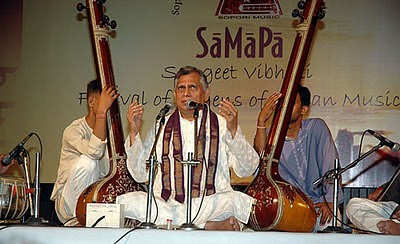
Pandit Vidyadhar Vyas (born September 8, 1944) is an Indian Hindustani vocalist, and a contemporary exponent of the Paluskar style of North Indian classical singing. He belongs to the prestigious Gwalior gharana and the illustrious lineage of Sangeet Maharshi Pandit Vishnu Digambar Paluskar contributed to his background. His molding of creative thinking, artistic approach and aesthetic research in the gharana gayaki with his arduous riyaz, he matured as a maestro in his own right.


Early life and background

Vidyadhar Vyas was born in Maharashtra to Gayanacharya Pandit Narayanrao Vyas, himself an outstanding disciple of Pandit Paluskar.. His khayal, tarana and bhajan gayaki by his renowned father.

He holds a Master's degree in Sociology from the University of Mumbai and a Doctorate in Hindustani Classical Vocal Music from the Akhil Bharatiya Gandharva Mahavidyalaya Mandal, Mumbai.

Career

Gifted with a voice that is mellow and musical, Pandit Vyas presents a unique and pleasing blend of beauty of form and content of khayal. He takes every care to sustain and develop the Raga rasa and tries to harmonize it with the bhava of the compositions.

Awarded Top Grade status by All India Radio, Pandit Vyas is an equally popular artiste in the television media and has several cassettes and CDs to his credit. A top-notch concert performer with creditable performances in almost all the major festivals in India, he has also performed in the USA, Europe, Mauritius and other parts of the world.

He has written several articles for leading music journals and has conceived and presented a variety of programmes on the genesis and evolution of Hindustani Raga Music. Pandit Vyas also excels in conducting lecture demonstrations, which are both enlightening and entertaining.

In addition to being a performing artist, Vidyadhar Vyas is known as a teacher. He has been teaching and mentoring students at undergraduate and postgraduate levels since 1964 and doctorate level since 1972. In 1973 he became Principal of the Government Music College (Rajasthan Sangeet Sansthan) at Jaipur. In 1984 he became Head of the Department of Music, University of Mumbai. In February 2004, he became the first duly selected Vice Chancellor of the newly formed Bhatkhande Music Institute Deemed University at Lucknow, Uttar Pradesh.

In August 2007 he took over as Executive Director of ITC Sangeet Research Academy, Kolkata. Vyas was awarded the Sangeet Natak Akademi Award in 2007.

Discography

* Suneri Maine Nirbalke Balraam

Bibliography

* Colors of the Night By Vidyadhar Vyas


Dr.Vasantrao Deshpande classical vocalists of Natya Sangeet

Dr.Vasantrao Deshpande was India's most illustrious classical vocalists.The scale of his versatility challenged all bounds of imagination. He handled all forms of music with awe-inspiring ease. In the "raag" form which constitutes classical music, the artist displays his creativity on a basic canvas. Dr. Vasantrao Deshpande's rendition of famous ragas like Marwa, Salag Waraali, Natbhairav, Kauns( in its various forms), Chayanat, Basant Mukhari, Patamanjiri, Jaijaiwanti, Janasammohini, Bhoop, Shree, Marubihag, Yaman etc. had a magical quality to them that kept people glued to their seats. His performance of offbeat ragas was not too different. The 'Sargam" was his forte. No other artist could impart so much variety and colour to the Sargam as he did. His delivery of "Taans" gave one the impression of a thousand lighnings crackling and dazzling in the sky, just before a heavy downpour.

Dr. Vasantrao Deshpande was equally at ease with the Thumri, Dadra an Ghazal forms. These find their origins in countries like Iran and Afghnanistan. Dr. Vasantrao Deshpande had picked up the original style and nuances of the thumri and ghazal while studying at Lahore. He also learnt quite a bit of Urdu to elevate his ghazal performances. Another area of music where he made his mark was " Marathi Natyasangeet". Some of the plays in which he acted and performed were "Katyaar Kaaljaat Ghusli", "He Bandha Reshmache", "Vij Mhanali Dhartila", "Meghmalhar", "Tukaram" and "Varyawarchi Varaat". Out of these, "Katyaar Kaaljaat Ghusli" became highly popular. Dr. Vasantraro Deshpande became the cynosure of everyone's eye for his challenging role of "Khan Aftaab Hussain Khansaheb". As the play's popularity began to soar, he acquired the alias, "Pandit Vasantkhan Deshpande".

Light, semi-classical and film music would hardly remain an exception to such a multi-talented person. He acted in movies like "Kaaliya Mardan"(he was just eight), "Dudh Bhaat", "Ashtavinayak" and many more. He gave playback to more than 80 Marathi films. Besides pure music, he also put together the history of Marathi music plays, from origin showing their evolution upto the present stage. This is how he presented his brainchild, his tour de force, " Marathi Natyasageetachi Vaatchaal". ( The evolution of music in Marathi music plays). In this he would first explain the socio-cultural influences that shaped the musicals as they stood in a particular era and then demonstrate the evolution through its music. The concert was first held in Delhi. It stretched for 3 days, 6 hours each day. The experiment was bound to be a winner with the audience.

Dr. Vasantrao Deshpande was an academician in his own right. He earned himself a PhD in "The Transformation of Hindustani Classical Music". He was also invited to several educational institutions to deliver lectures on music, quite often with live demonstrations. Dr. Vasantrao Deshpande was truly a genius.

As A Performer...

Dr.Vasantrao Deshpande had received the training under different gharanas (schools or styles of music): Patiyala, Bhendi Bazar, Kairana; yet he id not receive the stamp of any particular gharana.

He was a thinker and he blended these styles to develop a style of his own. He did not believe in imitation. Considering the timbre of his voice, pitch, range and expressive capacity, he forged his own characteristic style.

He usually began his exposition of a raag in the Jod-Aalap or 'Nom-Tom' style and created a kind of foundation for his musical statements. This created an aesthetic tension in the listener's minds and then he landed beautifully on the first beat of the khayal- the 'sum'. His development of the khayal was always full of such tensions and releases, which pleased the audience.

His concert was consists of Khayal, Thumari, Dadra Natya Geet, Gazal etc. A perfect amalgam of traditional classical as well as light music.

He had an equal command of both common and uncommon Ragas and a large repertoire of compositions. He presented them judiciously, considering the type of audience before him.


More details Visit :- http://vasantraodeshpande.com/

Thursday, February 17, 2011

Anoushka Shankar

Anoushka Shankar


Anoushka Shankar (born 9 June 1981) is an Indian sitar player and composer who lives between the United States, the United Kingdom, and India. She is the daughter of Ravi Shankar, legendary Indian sitar player, and Sukanya Shankar. Through her father, she is the half-sister of Norah Jones.

Personal life and education

Shankar was born in London and divided her childhood between London and Delhi. As a teenager, she lived in Encinitas, California and attended San Dieguito Academy. A 1999 Honors graduate, Shankar decided to pursue a career in music rather than attend college.

Anoushka married British director Joe Wright, and is expecting their first child in the spring of 2011.

Career

Anoushka and Ravi Shankar in concert, 2005

Shankar began training on the sitar with her father as a child, and gave her first public performance at the age of thirteen at Siri Fort in New Delhi. By the age of fourteen, she was accompanying her father at concerts around the world, and signed her first record contract, with Angel Records (EMI) at 16.

She released her first album, Anoushka, in 1998 followed by "Anourag" in 2000. Both Shankar and Norah were nominated for Grammy awards in 2003 when Anoushka became the youngest-ever and first woman nominee in the World Music category for her third-album, Live at Carnegie Hall.

2005 brought the release of Anoushka’s fourth album RISE, earning her another Grammy nomination in the Best Contemporary World Music category. In February 2006 she became the first Indian to play at the Grammy Awards.

Shankar, in collaboration with Karsh Kale, released Breathing Under Water on 28 August 2007. It is a mix of classical sitar and electronica beats and melodies. Notable guest vocals include Norah Jones, Sting, and Ravi Shankar who performs a sitar duet with his daughter.

Anoushka has made many guest appearances on recordings by other artists, among them Sting, Lenny Kravitz and Thievery Corporation. Duetting with acclaimed violinist Joshua Bell, in a sitar-cello duet with Mstislav Rostropovich, and with flautist Jean-Pierre Rampal, playing both sitar and piano. Most recently Anoushka has collaborated with Herbie Hancock on his latest record The Imagine Project.

Anoushka has given soloist performances of her Father’s 1st Concerto for Sitar and Orchestra worldwide. In January 2009 she was the sitar soloist alongside the Orpheus Chamber Orchestra for the series of concerts premièring her Father’s 3rd Concerto for Sitar and Orchestra, and in July of 2010 she premiered Ravi Shankar's first Symphony for Sitar and Orchestra with the London Philharmonic Orchestra at London's Barbican Hall.

Anoushka has also ventured into acting (Dance Like a Man, (2004)) and writing. She authored a biography of her father, Bapi: The Love of My Life, in 2002 and has contributed chapters to various books. As a columnist she wrote monthly columns for India's First City Magazine for three years, and spent one year as a weekly columnist for India's largest newspaper, the Hindustan Times.

Anoushka is currently working on a new album in Madrid, Spain.

Benefit concerts

On 29 November 2002, she performed George Harrison's “The Inner Light” and conducted a new composition written by her father, Arpan, which featured Eric Clapton on solo guitar at the Concert for George held at the Royal Albert Hall in London. It was held in memory of George Harrison and was modeled after Ravi Shankar's benefit concert with Harrison, the 1971 Concert for Bangladesh.

Anoushka Shankar was invited by Richard Gere and Philip Glass to perform in a concert at the Avery Fisher Hall in 2003 in aid of the HEALING THE DIVIDE FOUNDATION: A CONCERT FOR PEACE AND RECONCILIATION. Shankar and Jethro Tull postponed a concert scheduled for 29 November 2008 in Mumbai [4] after the November 2008 Mumbai attacks. They reorganized the performance as A Billion Hands Concert, a benefit performance for victims of the attacks, and held it on 5 December 2008.[5] Shankar commented on this decision stating that: "As a musician, this is how I speak, how I express the anger within me [...] our entire tour has been changed by these events and even though the structure of the concert may remain the same, emotionally perhaps we are saying a lot more."


Awards

* British House of Commons Shield, 1998
* Voted Homecoming Queen of San Dieguito High School, Class of 1999
* Woman of the Year (shared with Kareena Kapoor, Ritu Beri, and Rhea Pillai) awarded on International Women's Day 2003
* named as one of 20 Asian Heroes by the Asia edition of Time magazine in 2004

Activism

Shankar is a supporter of animal rights and People for the Ethical Treatment of Animals (PETA). She and her father appeared in a thirty-second public-service announcement against animal suffering. Anoushka is also the spokesperson for the United Nations World Food Program in India.


Discography
Studio albums

* Anoushka (1998)
* Anourag (2000)
* Live at Carnegie Hall (2001)
* Rise (2005)
* Rise (2006)
* Breathing Under Water (2007)

Live and compilations

* Full Circle: Live at Carnegie Hall- Ravi Shankar (2000)
* Concert for George (2003)
* Healing the Divide: A Concert for Peace and Reconciliation (2007)
* Live In Concert at the Nehru Park, New Delhi (2005)


Features

* Variant Moods - Duet For Sitar & Violin (Abridged Version) Written by Ravi Shankar, At Home With Friends by Joshua Bell 2009
* Charu Keshi Rain - Co-written by Nitin Sawhney and Anoushka Shankar, London Undersound 2008
* Mandala - Featuring Anoushka Shankar on sitar. Co-written by Hilton Garza, Radio Retaliation
* Beloved - by Anoushka Shankar remixed by Thievery Corporation - Versions 2006
* Rebirth - Co-written by Gaurav Raina, Tapan Raj and Anoushka Shankar. MIDIval Times 2005
* Sacred Love - by Sting 2003
* 8 classical ragas performed on ShankaRagamala composed by Ravi Shankar 2005
* Chants Of India - Ravi Shankar; George Harrison, Featuring Anoushka as Conductor & Assistant 1997
* Adarini - In Celebration composed by Ravi Shankar 1995

More about Anoushka Shankar


Anoushka Shankar Live at Verbier Festival - Mishra Pilu

Aditya Kalyanpur

Aditya Kalyanpur


Aditya Kalyanpur (born 21st July 1978) is an Indian Tabla player. He belongs to the Punjab gharana.

Early life and background

Aditya Kalyanpur was born in Mumbai, India.

He began his studies at the age of five under the guidance of Tabla Maestro late Alla Rakha Khan and his son Zakir Hussain.

He is a commerce graduate.

Performing career

Aditya Kalyanpur was initially known for his debut performance with his guru Zakir Hussain for the Wah Taj! commercial when he was 11 years old.

His style consists of bold and clear execution of syllables, pinpoint precision in rhythm coupled with a colossal repertoire of compositions and improvisational technique.[citation needed]

He has accompanied artists including Shivkumar Sharma, Amjad Ali Khan, Prabha Atre, N. Rajam, Sultan Khan, Shahid Parvez, Vishwa Mohan Bhatt, Satish Vyas, Shujaat Khan, and Nayan Ghosh. He has also accompanied Carnatic performers including T. N. Krishnan, N. Ramani, U. Shrinivas, and Lalgudi Krishnan. Currently on tour with AR Rahman for his JAI HO World Tour![citation needed]

Awards

* “A” Grade Artist of All India Radio
* ‘Taal – Mani’ by Sur Singar Samiti
* Vidyasagar Award, ITC
* Sangeet Visharad
* National Scholarship for Advanced Training, Government of India
* Awardee of Pandit Jasraj Competition, Vedic Heritage Center, Long Island, New York

Performances

* Orient Arts Festival, Estonia
* Edinburgh festival, Scotland (2003)
* Earagal Arts Festival, Ireland
* Jazz Yatra, Mumbai
* Great Lakes Folk Festival, Lansing, Michigan
* Saptak Festival


More About Aditya Kalyanpur.

Having age by his side, young tabla percussionist Aditya Kalyanpur has turned miles into milestones.

The Tabla, one of the most versatile of world percussion instruments, is a very important accompanying instrument in the world of Indian classical music. It is absolutely essential for the main artist and the accompanying Tabla player in any performance situation to vibe well on stage in order to reach the audience at large.

Beginning his studies at the age of five under the vigilance of Tabla Maestro late Ustad Allarakha and tabla Maestro Ustad Zakir Hussain, Aditya is considered as one of the most promising torchbearers of the Punjab Gharana style of tabla performance.

Aditya was first seen with his Guru Ustad Zakir Hussain for the famous “Wah Taj!” television commercial at the age of 11. Having the honor of being recognized as an “A” Grade Artist of All India Radio, he has given public performances along with his Guru. Since then he has lent the enchanting music of his tabla to numerous commercials. We hear his Tabla ringing in the background of the film “Everybody Says I am Fine” where Zakir Hussain composed the background score.

To quote the acknowledging words of Tabla maestro Ustad Zakir Hussain for his young, talented disciple; “Even a young player like, say, Aditya Kalyanpur has the ability to approach the instrument with much more expertise than someone of his age would do 30 years ago.”

As a young man, Aditya has lived up to the words and reputation of his teachers, mastering the intricacies of the tabla to smoothly accommodate himself to the requirements of the main artist. His style consists of bold and clear execution of syllables, pinpoint precision in rhythm coupled with a colossal repertoire of compositions and improvisational techniques, making his concerts a sheer joy.

As a young Tabla player, Aditya has had the honor of accompanying great maestros of Indian classical music such as Pandit Shivkumar Sharma, Ustad Amjad Ali Khan, Dr. Prabha Atre, Dr. Mrs N Rajam, Ustad Shamim Ahmed Khan, Ustad Sultan Khan, Ustad Shahid Parvez, Pandit VishwaMohan Bhat, Pandit Satish Vyas, Ustad Shujaat Khan, Pandit Nayan Ghosh as well as Kathak dancers such as Shama Bhate, Sunaiyana Hazarilal, Late Madhurita Sarang, and many others as time has passed, such as Carnatic music legends Vidwan TN Krishnan, N. Ramani, U. Srinivas and Lalgudi Krishnan.

Honored with the title of ‘Taal – Mani’, Aditya Kalyanpur is the recipient of I.T.C’s prestigious “Vidyasagar Award” as well as the “Sangeet Visharad.” A commerce graduate, Aditya Kalyanpur pursued and has also achieved distinction grades as a Music Diplomate from Mumbai University. He has received scholarship from the Centre for Cultural Resources and Training, New Delhi. A recipient of the National Scholarship for Advanced Training instituted by the Government of India, Aditya has also won the prestigious Pandit Jasraj Competition held at the Vedic Heritage Center, Long Island, New York.

In addition to many awards given in India and the United States, Aditya is one of the first tabla players ever to be invited to Estonia for the prestigious Orient Arts Festival. As a soloist and accompanist, Aditya has performed at other prestigious music festivals in India and abroad including the Edinburgh festival in Scotland (2003), the Earagal Arts Festival in Ireland, and the Jazz Yatra (Bombay).On a more local scene, Aditya has also appeared at the Great Lakes Folk Festival held every year in Lansing, Michigan, and many other such festivals and competitions held across the United States.

As a mark of his true versatility and the regard which many different groups in many different genres have for Aditya as a performer, he has performed solo for many bands and instrumental groups, to include the world famous rock and roll group the Rolling Stones and also recorded for their saxophonist, Tim Ries.

Aditya is currently a band leader of his fusion band ‘Fuzikk’, and a member of the world renowned group ‘Bombay Jazz’ comprised of Jazz legends Larry Coryell, George Brooks and Indian Flute Maestro Pandit Ronu Mazumdar. Aditya has made several guest appearances with many other groups over time, including the Boston-based world renowned Jazz group ‘Natraj’.

Wanting to give back as one who has been offered so much, Aditya has been part of several fund-raising and charity events for Asha Foundation’s Notes of Hope with Santoor Legend Padmavibhushan Pandit Shivkumar Sharma and Amma Foundation’s fund-raising events with Rahul Sharma for the 2005 Boxing Day Tsunami victims.

Based in Mumbai, India carving a niche for himself on the United States and international circuits. His schedule finds him giving numerous solo performances, and accompanying artists in overseas and stateside venues such as MIT, Harvard, Cornell, and Yale just to name a few. He also has the honor of being a Tabla Faculty Member at the prestigious Harvard University’s Sangeet Music School and Raganjali School of Music, Boston.

Aditya Kalyanpur can be reached via email at aditya@adityatabla.com Please allow time for him to respond to queries and emails, as his schedule requires long hours and traveling.


Aditya Kalyanpur goes beyond borders

Aditya Kalyanpur


Monday, December 20, 2010

Alla Rakha

Alla Rakha
Alla Rakha


Qureshi Alla Rakha Khan (Dogri: क़ुरैशी अल्ला रखा ख़ान) popularly known as Alla Rakha (29 April 1919 – 3 February 2000) was an Indian tabla player. He was a frequent accompanist of Ravi Shankar.

Personal life and education

Alla Rakha was born in Paghwal, District Samba Division, Jammu, India. His mother tongue was Dogri. He became fascinated with the sound and rhythm of the tabla at the age of 12, while staying with his uncle in Gurdaspur. The determined young lad ran away from home, became a disciple of and began studying tabla with Mian Kader Baksh of the Punjab gharana. He studied voice and Raag Vidya under Ashiq Ali Khan of the Patiala gharana. His regimen of practice and dedication were legendary: hours upon hours of hard, disciplined practice, that would later pay off.

He was married to Bavi Begum, and has three sons, Zakir Hussain, Fazal Qureshi and Taufiq Qureshi, a daughter Khurshid Aulia née Qureshi, and nine grandchildren. Alla Rakha had another daughter, Razia, whose death preceded his by less than 24 hours.


Career

Alla Rakha began his career as an accompanist in Lahore and then as an All India Radio staffer in Bombay in 1940, playing the station's first ever tabla solo and elevating the instrument's position in the process. Soon after, he composed music for a couple of Hindi films from 1943-48.

However, he still played as an accompanist, for soloists like Bade Ghulam Ali Khan, Allauddin Khan, Vasant Rai and Ravi Shankar. The venerable master achieved world renown as Ravi Shankar's chief accompanist during his apex in the 1960s, delighting audiences in the West with his percussive wizardry, not only as an uncanny accompanist with flawless timing and sensitivity but also as a soloist where he was a master of improvisation, a prolific composer and an electric showman. The partnership was particularly successful, and his legendary and spellbinding performances with Shankar at the Monterey Pop Festival in 1967 and the Woodstock Festival in 1969 served to introduce classical Indian music to general Western audiences.

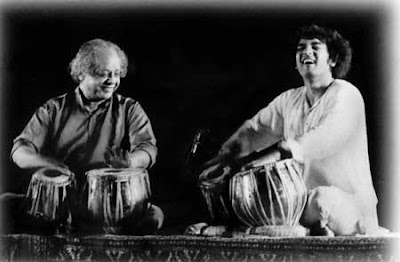
He became a Guru (or teacher) to Yogesh Samsi, Prafulla Athalye, Aditya Kalyanpur, Anuradha Pal, Uday Ramdas, Shyam Kane, and his sons Taufiq Qureshi and Fazal Qureshi. His eldest son, Zakir Hussain is also an accomplished tabla virtuoso.


Global influence

Rakha popularized the art of tabla, playing across the globe, elevating the status and respect of his instrument. Abbaji (as he was affectionately known by his disciples) also bridged the gap between Carnatic music and Hindustani music by playing with both renowned Carnatic musicians and other Hindustani stalwarts.

Leading American percussionists in Rock n' Roll, such as the Grateful Dead's Mickey Hart, admired him and studied his technique, benefiting greatly even from single meetings. Hart, a published authority on percussion in world music, said "Allarakha is the Einstein, the Picasso; he is the highest form of rhythmic development on this planet." Rakha also collaborated with jazz drummer Buddy Rich, on their 1968 album Rich Ala Rahka.[2]

Rakha was awarded the Padma Shri in 1977[3] and the Sangeet Natak Akademi Award in 1982.


Death

Alla Rakha died on 3 February 2000 at his Simla House residence on Nepean Sea Road following a heart attack, which he suffered on learning of the death of his daughter, Razia, the previous evening

Ustad Allah Rakha & Zakir Hussain Tabla Solo Teental


Ravi Shankar, Alla Rakha - Tabla Solo in Jhaptal

Thursday, December 9, 2010

Pandit Jasraj

Pandit Jasraj


Early life

Jasraj was born in Hissar, Haryana in an orthodox brahmin family to Pandit Motiramji, a classical exponent. His family is well known for singing in the Mewati Gharana style. Motiramji died when Jasrajji was only four, on the day he was to be appointed as the state musician in the court of the Last Nizam.
Jasraj was initiated into vocal music by his father. He also received training from his elder brother, Pandit Maniramji, and later from Maharaja Jaywant Singhji Waghela. He was also greatly influenced by the voice of the famous ghazal singer, Begum Akhtar, whom he used to listen to, skipping school, at a small hotel that played her songs all day. This inspired him to learn vocal music.
In 1960, when Jasraj went to visit Bade Ghulam Ali Khan in hospital, Khan asked him to become his disciple, but Jasraj declined saying that he could not accept Khan's tutelage since he was already Motiram's disciple.
As a means of livelihood, Maniramji took Jasraj as an accompanying tabla player. However, at the time, just like sarangi players, tabla players were looked down upon as minor artists. At the age of 14, unhappy with his treatment as an accompanying artist, Jasraj left and vowed not to cut his hair until he learned to sing.


Performing career


Jasraj at the Pandit Motiram Pandit Maniram Sangeet Samaroh, Hyderabad, in 2007
Jasraj's vocal range extends across three-and-a-half octaves. His vocalizing is in perfect diction and clarity, a trademark of the Mewati Gharana's style of Khayal. He has also done extensive research in Haveli Sangeet under Baba Shyam Manohar Goswami Maharaj to create numerous innovative bandish (composition).
His greatest contribution to Indian classical music is his conception of a unique and novel jugalbandi, styled on the ancient system of Moorchana, between a male and a female vocalist, each singing in their respective scales and different ragas at the same time. In his honor, this legendary jugalbandi is known as The Jasrangi[3].
Jasraj has many students, and is ensuring the longevity of his genre. Amongst his flag-bearing disciples, Rattan Mohan Sharma, Sanjeev Abhyankar, Suman Ghosh, Tripti Mukherjee, Radharaman Kirtane, Pritam Bhattacharjee, Gargi Siddhant and Kala Ramnath are well-known exponents of the Mewati Gharana. Sadhana Sargam, a well-known Bollywood singer, is one of his disciples.
In memory of his late father, he organises a musical festival every year called the Pandit Motiram Pandit Maniram Sangeet Samaroh in Hyderabad, India. It completed 36 years in 2008. He has graced the Savai Gandharva Music Festival's stage innumerable times over the last forty years, and continues to do so even today; his legendary 1992 presentation of Raag Ahir Bhairav, in the unmistakable Mewati Style, is a favorite among listeners even today. He is also recognized as a master of the Bhairav family of Raags, along with the legendary Raags Darbari Kanada, Miya ki Malhar, and Jog.

Personal life

In 1962 he married Madhura, the daughter of the legendary film director V. Shantaram, who he had first met in 1955 during the filming of Jhanak Jhanak Payal Baje, as Jasraj then employed with AIR as a freelance artist wanted to join V. Shantaram’s production company as a musician. After marriage the couple lived in Kolkata for some time. They have a son, Sarang Dev, and a daughter, Durga Jasraj, a television anchor and presenter. Madhura Jasraj has directed documentaries, children’s plays, apart from directing and producing acclaimed ballets, Geet Govind, Kaan Kahaani and Surdas and the TV series, Faster Phene. She made a film, Sangeet Martand Pandit Jasraj on Pandit Jasraj, in 2009 and in 2010, directed her first Marathi film, Aai Tuzha Aashirwad, in which Lata Mangeshkar and her husband have sung in Marathi

Music composers Jatin-Lalit are his nephews


Awards

Padma Vibhushan, (art-classical music-vocal) in 2000
Sangeet Natak Akademi Award in 1987
Sangeet Kala Ratna
Master Dinanath Mangeshkar Award
Lata Mangeshkar Puraskar
Maharashtra Gaurav Puraskar
Surer Guru
Sangeet Natak Akademi Fellowship


Discography

Raga Symphony (2009)
Baiju Bawra (2008)
Upasana (2007)
Tapasya Vol. 1 (2005)
Darbar (2003)
Maheshwara Mantra (2002)
Soul Food (2005)
Jasraj, Pandit Vol. 2 - Haveli Sangeet
Inspiration (2000)
Ragas Triveni and Multani Live
Ragas Bihada and Gaud Giri Malhar
Worship By Music/Live Stuggart '88
Ornamental Voice
Filmography
Ladki Sahyadri Ki (1966, music by Vasant Desai)
Birbal My Brother (1973, music by Shyam Prabhakar)
1920 (2008, music by Adnan Sami)


Friday, November 26, 2010

Pandit Shivkumar Sharma

Pandit Shivkumar Sharma

Shivkumar Sharma

Sharma performing in Pune, 17 July 2009
Background information
Born January 13, 1938 (age 72)
Jammu Jammu & Kashmir
Origin Dogra from Jammu, India
Genres Hindustani classical music
Instruments santoor
Years active 1955–present
Associated acts Rahul Sharma
Website www.santoor.com
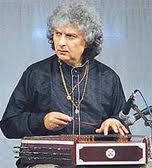
Shivkumar Sharma (born January 13, 1938, Jammu, India) is an Indian santoor player. The santoor is a folk instrument from the valley of Kashmir. Sharma is often referred to by the title Pandit.

1 Early life
2 Career
3 Personal life
4 Awards
4.1 Awards (classical and film)
5 Discography
6 References
7 External links
Early life

Born in Jammu to the singer Uma Dutt Sharma. In a 1999 interview to rediff.com, Sharma said that his father started teaching him vocals and tabla when he was just five.He goes on to say that Uma Dutt Sharma did "extensive research" on santoor and decided that Shivkumar should be the first musician to play Indian classical music on santoor. So he started learning santoor at the age of 13. and made Uma Dutt Sharma's dream come true.[1] He gave his first public performance in Bombay in 1955. His mother tongue is Dogri.


Career


Sharma in 1988
Shivkumar Sharma is the master instrumentalist of the santoor, after some years as a vocalist. He is credited with making the santoor a popular classical instrument.[4][10] In a 1999 interview to rediff.com, Sharma said that it was his father who decided that he should play the santoor and that he never thought he would be choosing it when he started learning music.[8] Sharma recorded his first solo album in 1960. Sharma composed the music of Shantaram's Jhanak Jhanak Payal Baje (1965).
In 1967, he teamed up with flautist Hariprasad Chaurasia and Brij Bhushan Kabra to produce a concept album, Call of the Valley (1967) which turned out to be one of the greatest hits in Indian classical music.[1][10] He has composed music for many Hindi films in collaboration with Hariprasad Chaurasia starting with Silsila[11] (1980). They came to be known as the 'Shiv-Hari' music duo.[11] Some of the movies they composed music for which were big musical hits are Faasle (1985), Chandni (1989), Lamhe (1991) and Darr (1993).
[edit]Personal life

Sharma married Manorama and has two sons.[8] His son, Rahul, is also a santoor player and they perform together since 1996. In a 1999 interview to rediff.com, Sharma stated that he chose Rahul as his shishya because he thought he had the "gift of God".

Awards

Sharma is the recipient of national and international awards, including an honorary citizenship of the city of Baltimore, USA, in 1985, the Sangeet Natak Akademi Award in 1986,[19] the Padma Shri in 1991, and the Padma Vibhushan in 2001.

Awards (classical and film)
Platinum Disc for Call of the Valley
Platinum Disc for music of film Silsila
Gold Disc for music of film Faasle
Platinum Disc for music of film Chandni
Special Award for outstanding music and sale of film Lamhe
Special Award for outstanding music and sale of film Darr
[edit]Discography

Call of the Valley, with Brij Bhushan Kabra and Hariprasad Chaurasia (1967)
The Glory Of Strings - Santoor (1991), T-Series
Raga Bhopali vol I (1993)
Raga Kedari vol II (1993)
Hundred Strings of Santoor (1994)
Hypnotic Santoor (1994)
The Pioneer of Santoor (1994)
Raag Bilaskhani Todi (1994)
Santoor (Raag Rageshri) (1998)
Sampradaya (1999)
Vibrant Music for Reiki (2003)
Sympatico (Charukeshi - Santoor)(2004)
The Inner Path (Kirvani - Santoor) (2004)


Wednesday, November 24, 2010

Pandit Chatur Lal

Pandit Chatur Lal

14th Oct, 1965, India lost a great Tabla Wizard with the untimely death of Pandit Chatur Lal at the young age of 40. The violinist virtuoso, Late Lord Yehudi Menuhin, once remarked "Pandit Chatur Lal was one of those few supreme pioneer musicians who won for India the great and growing following it now commands in the West. He stole the hearts of his audiences wherever he went with his art and his enchanting personality".

Pandit Chatur Lal himself observed, "All My Efforts Served A Single Purpose: Sangat Both In Art And Life."

Pandit Chatur Lal was the first Indian percussionist to take Indian drums ‘Tabla’ to the West in 1955 with Usatd Ali Akbar Khan then in 1956-57 with Pandit Ravi Shankar and so on.

He was also the first Indian musician who’s tabla solo LP was released both in the East & the West. A German disciple then the Director of Max Muller Bhawan, Dr. Heimo Rau, called him 'the incarnation of the god of music' who opened to the listener a fourth dimension of experience beyond time and space.

Born on April 16, 1926 in Uadipur, Rajasthan. While yet a boy, Chatur Lal started a vigorous period of long and continues practice, which is the only way to attain perfection. Night after night Chatur Lal's drum-beating became a source of nuisance for the local policeman in the night duty. One day the policeman lost his patience and knocked at the door and burst upon him: "You should be in bed at this time. You have no business to keep the locality awake." A little frightened but undaunted, the little boy went on playing the Tabla every night, except when it was the time for the policemen to pass their house.

In 1947, Chatur Lal came to Delhi and joined All India Radio. Since 1948, he regularly participated in programmes and conferences all over the India and Abroad. He played with masters like to name few Baba Allaudin Khan, Pandit Onkarnath Thankur, Pt. Ravi Shakar, Pandit, Ustad Ali Akbar Khan, Ustad Vilayat Khan, Pt. Nikhil Banerjee and many others.

In 1952, he went to Afghanistan with Pandit Omkarnath Thakur and in 1955, he visited Britain and United States on the invitation of Museum Of Modern Art and OMNIBUS, the Rockefeller Ford Foundation TV Workshop in performances with Sarod Maestro, Usatd Ali Akbar Khan. In 1956-57, he toured to North America and Europe with one of the greatest sitar maestro Pandit Ravi Shankar and in 1960 he visited the Soviet Union and Mongolia with Indian delegations. In 1961, he went on a World tour with Mrs. Sharan Rani.

His Second tour included the first ever fusion concert between the East & the West where Chatur Lal representing his Indian drums 'Tabla' and greatest drummer Sir Philly Joe Jones representing his Western drums.

His last trip was in 1964 in association with Max Muller Bhawan, he organized a concert for his younger brother , Pt. Ram Narayan to West Germany which included 25 cities. Dr. Heimo Rau commented, "In India and Germany will never forget him since for them he opened that gate to the Indian music." This trip also took two brothers to France and Britain.

Commenting on the performances of Chatur lal, The famous German Newspaper, Frankfurter Rundschan, said "Our little drums are stuck with sticks. However virtuoso they may be, yet compared to the art of the Indian Tabla player, Chatur lal they sound barbarian. His playing sometimes sound like rhythmically arranged drops of rain, sometimes the finger flew over the membranes like a family of salamanders."

Chatur lal developed a style of his own, noted for a lightning rhythmic pattern and an intimate understanding of the mood of the artiste he accompanied "his style", Mr. Lothar Lutze of Max Muller Bhawan said, "amalgamated" many different elements, among them south Indians ones, and with the artiste on his standing, became a personality – bound pure style. He always showed an uncanny adroitness and skill in his accompaniment, while his solo was notable for case, clarity, diversity and grace where that were all his own.

On the occasion of the Paluskar Musical Festival in Delhi in 1960, the music critic of the Statesman aptly commented on the style of the great percussionist "After the interval Chatur lal gave a fine Tabla recital." Playing with great skills and finesse and weaving his percussion sonorities into every conceivable caprice of form of rhythm, he gave proof of his supreme command of the instrument. With perfect coordination between the two hands, the artiste played with tremendous zest and fervor passing at times into a mood of rhythmical abandon. It was a most impressive recital – forceful, fluent and almost unbelievably elemental in its rhythmic appeal.

The "Drums of India" and "Drums On Fire" are some of the important solo recordings of Pandit Chatur Lal in Hollywood's 'World Pacific Recordings'. He also composed and gave music for a short animated Canadian film 'A Chairy Tale', 'A Certain View', 'Now what my Little Man'. A French Television also made a short documentary film on him "Rythmes d'aillenres".