Search This Blog

Showing posts with label tabla. Show all posts

Monday, March 11, 2013

Taufiq Qureshi - A Percussionist


Taufiq Qureshi (born 1955) is an Indian classical musician. He is a percussionist and a composer.
Son of legendary tabla player, Ustad Alla Rakha and younger brother of the Great Ustad Zakir Hussain.
Born in a family where tabla was the bread and butter, there were these two pillars, his father Ustad Allarakha and brother Ustad Zakir Hussain, who were always there guiding and getting him ready for the world of rhythm. Since the time he started playing on stage and rhythm-programming in studios, he always wanted to work on exploring wider prospects of world rhythm through composing, music production and the ever inspiring world of live performances. With Zakirbhai's inspirational support, his parents’ blessings and his wife Geetika’s support and understanding push he plunged into the exquisite, exotic and exciting world of rhythm
Career
Taufiq Quereshi started his career early. His stint with live performances began with the creation of his own world music band, ‘Surya’ way back in 1986-87. He has been featured as a performing artiste on the 2009- Grammy award winning album Global Drum Project, Remember Shakti, Masters of Percussions and Summi. He collaborates with various classical artists for fusion concerts. He plays a variety of percussion instruments like djembe, duff, bongos, batajon. His performance on drums with a soft beat of a muffled drum and the very next moment ups the tempo and demonstration of different sounds - like breath, rhythm, breaking a champagne bottle, the sound of the train and the arrival of people, horses and others on arrival at the palace on the drums are quite popular Discography
Rhydhun (2000) Swar Utsav - Streams In Confluence (2001) Rhydhun Gold (2002) Mondo Beat - Masters of Percussion India The Greatest Songs Ever Taalisma (2002) Colours of Rajasthan (1995) PercJam (2003) Bombay Fever (2006) Mystic Soundscapes - Forest (2007) Rooh - Songs From The Heart (2007)

Thursday, February 17, 2011

Aditya Kalyanpur

Aditya Kalyanpur


Aditya Kalyanpur (born 21st July 1978) is an Indian Tabla player. He belongs to the Punjab gharana.

Early life and background

Aditya Kalyanpur was born in Mumbai, India.

He began his studies at the age of five under the guidance of Tabla Maestro late Alla Rakha Khan and his son Zakir Hussain.

He is a commerce graduate.

Performing career

Aditya Kalyanpur was initially known for his debut performance with his guru Zakir Hussain for the Wah Taj! commercial when he was 11 years old.

His style consists of bold and clear execution of syllables, pinpoint precision in rhythm coupled with a colossal repertoire of compositions and improvisational technique.[citation needed]

He has accompanied artists including Shivkumar Sharma, Amjad Ali Khan, Prabha Atre, N. Rajam, Sultan Khan, Shahid Parvez, Vishwa Mohan Bhatt, Satish Vyas, Shujaat Khan, and Nayan Ghosh. He has also accompanied Carnatic performers including T. N. Krishnan, N. Ramani, U. Shrinivas, and Lalgudi Krishnan. Currently on tour with AR Rahman for his JAI HO World Tour![citation needed]

Awards

* “A” Grade Artist of All India Radio
* ‘Taal – Mani’ by Sur Singar Samiti
* Vidyasagar Award, ITC
* Sangeet Visharad
* National Scholarship for Advanced Training, Government of India
* Awardee of Pandit Jasraj Competition, Vedic Heritage Center, Long Island, New York

Performances

* Orient Arts Festival, Estonia
* Edinburgh festival, Scotland (2003)
* Earagal Arts Festival, Ireland
* Jazz Yatra, Mumbai
* Great Lakes Folk Festival, Lansing, Michigan
* Saptak Festival


More About Aditya Kalyanpur.

Having age by his side, young tabla percussionist Aditya Kalyanpur has turned miles into milestones.

The Tabla, one of the most versatile of world percussion instruments, is a very important accompanying instrument in the world of Indian classical music. It is absolutely essential for the main artist and the accompanying Tabla player in any performance situation to vibe well on stage in order to reach the audience at large.

Beginning his studies at the age of five under the vigilance of Tabla Maestro late Ustad Allarakha and tabla Maestro Ustad Zakir Hussain, Aditya is considered as one of the most promising torchbearers of the Punjab Gharana style of tabla performance.

Aditya was first seen with his Guru Ustad Zakir Hussain for the famous “Wah Taj!” television commercial at the age of 11. Having the honor of being recognized as an “A” Grade Artist of All India Radio, he has given public performances along with his Guru. Since then he has lent the enchanting music of his tabla to numerous commercials. We hear his Tabla ringing in the background of the film “Everybody Says I am Fine” where Zakir Hussain composed the background score.

To quote the acknowledging words of Tabla maestro Ustad Zakir Hussain for his young, talented disciple; “Even a young player like, say, Aditya Kalyanpur has the ability to approach the instrument with much more expertise than someone of his age would do 30 years ago.”

As a young man, Aditya has lived up to the words and reputation of his teachers, mastering the intricacies of the tabla to smoothly accommodate himself to the requirements of the main artist. His style consists of bold and clear execution of syllables, pinpoint precision in rhythm coupled with a colossal repertoire of compositions and improvisational techniques, making his concerts a sheer joy.

As a young Tabla player, Aditya has had the honor of accompanying great maestros of Indian classical music such as Pandit Shivkumar Sharma, Ustad Amjad Ali Khan, Dr. Prabha Atre, Dr. Mrs N Rajam, Ustad Shamim Ahmed Khan, Ustad Sultan Khan, Ustad Shahid Parvez, Pandit VishwaMohan Bhat, Pandit Satish Vyas, Ustad Shujaat Khan, Pandit Nayan Ghosh as well as Kathak dancers such as Shama Bhate, Sunaiyana Hazarilal, Late Madhurita Sarang, and many others as time has passed, such as Carnatic music legends Vidwan TN Krishnan, N. Ramani, U. Srinivas and Lalgudi Krishnan.

Honored with the title of ‘Taal – Mani’, Aditya Kalyanpur is the recipient of I.T.C’s prestigious “Vidyasagar Award” as well as the “Sangeet Visharad.” A commerce graduate, Aditya Kalyanpur pursued and has also achieved distinction grades as a Music Diplomate from Mumbai University. He has received scholarship from the Centre for Cultural Resources and Training, New Delhi. A recipient of the National Scholarship for Advanced Training instituted by the Government of India, Aditya has also won the prestigious Pandit Jasraj Competition held at the Vedic Heritage Center, Long Island, New York.

In addition to many awards given in India and the United States, Aditya is one of the first tabla players ever to be invited to Estonia for the prestigious Orient Arts Festival. As a soloist and accompanist, Aditya has performed at other prestigious music festivals in India and abroad including the Edinburgh festival in Scotland (2003), the Earagal Arts Festival in Ireland, and the Jazz Yatra (Bombay).On a more local scene, Aditya has also appeared at the Great Lakes Folk Festival held every year in Lansing, Michigan, and many other such festivals and competitions held across the United States.

As a mark of his true versatility and the regard which many different groups in many different genres have for Aditya as a performer, he has performed solo for many bands and instrumental groups, to include the world famous rock and roll group the Rolling Stones and also recorded for their saxophonist, Tim Ries.

Aditya is currently a band leader of his fusion band ‘Fuzikk’, and a member of the world renowned group ‘Bombay Jazz’ comprised of Jazz legends Larry Coryell, George Brooks and Indian Flute Maestro Pandit Ronu Mazumdar. Aditya has made several guest appearances with many other groups over time, including the Boston-based world renowned Jazz group ‘Natraj’.

Wanting to give back as one who has been offered so much, Aditya has been part of several fund-raising and charity events for Asha Foundation’s Notes of Hope with Santoor Legend Padmavibhushan Pandit Shivkumar Sharma and Amma Foundation’s fund-raising events with Rahul Sharma for the 2005 Boxing Day Tsunami victims.

Based in Mumbai, India carving a niche for himself on the United States and international circuits. His schedule finds him giving numerous solo performances, and accompanying artists in overseas and stateside venues such as MIT, Harvard, Cornell, and Yale just to name a few. He also has the honor of being a Tabla Faculty Member at the prestigious Harvard University’s Sangeet Music School and Raganjali School of Music, Boston.

Aditya Kalyanpur can be reached via email at aditya@adityatabla.com Please allow time for him to respond to queries and emails, as his schedule requires long hours and traveling.


Aditya Kalyanpur goes beyond borders

Aditya Kalyanpur


Monday, December 20, 2010

Alla Rakha

Alla Rakha
Alla Rakha


Qureshi Alla Rakha Khan (Dogri: क़ुरैशी अल्ला रखा ख़ान) popularly known as Alla Rakha (29 April 1919 – 3 February 2000) was an Indian tabla player. He was a frequent accompanist of Ravi Shankar.

Personal life and education

Alla Rakha was born in Paghwal, District Samba Division, Jammu, India. His mother tongue was Dogri. He became fascinated with the sound and rhythm of the tabla at the age of 12, while staying with his uncle in Gurdaspur. The determined young lad ran away from home, became a disciple of and began studying tabla with Mian Kader Baksh of the Punjab gharana. He studied voice and Raag Vidya under Ashiq Ali Khan of the Patiala gharana. His regimen of practice and dedication were legendary: hours upon hours of hard, disciplined practice, that would later pay off.

He was married to Bavi Begum, and has three sons, Zakir Hussain, Fazal Qureshi and Taufiq Qureshi, a daughter Khurshid Aulia née Qureshi, and nine grandchildren. Alla Rakha had another daughter, Razia, whose death preceded his by less than 24 hours.


Career

Alla Rakha began his career as an accompanist in Lahore and then as an All India Radio staffer in Bombay in 1940, playing the station's first ever tabla solo and elevating the instrument's position in the process. Soon after, he composed music for a couple of Hindi films from 1943-48.

However, he still played as an accompanist, for soloists like Bade Ghulam Ali Khan, Allauddin Khan, Vasant Rai and Ravi Shankar. The venerable master achieved world renown as Ravi Shankar's chief accompanist during his apex in the 1960s, delighting audiences in the West with his percussive wizardry, not only as an uncanny accompanist with flawless timing and sensitivity but also as a soloist where he was a master of improvisation, a prolific composer and an electric showman. The partnership was particularly successful, and his legendary and spellbinding performances with Shankar at the Monterey Pop Festival in 1967 and the Woodstock Festival in 1969 served to introduce classical Indian music to general Western audiences.

He became a Guru (or teacher) to Yogesh Samsi, Prafulla Athalye, Aditya Kalyanpur, Anuradha Pal, Uday Ramdas, Shyam Kane, and his sons Taufiq Qureshi and Fazal Qureshi. His eldest son, Zakir Hussain is also an accomplished tabla virtuoso.


Global influence

Rakha popularized the art of tabla, playing across the globe, elevating the status and respect of his instrument. Abbaji (as he was affectionately known by his disciples) also bridged the gap between Carnatic music and Hindustani music by playing with both renowned Carnatic musicians and other Hindustani stalwarts.

Leading American percussionists in Rock n' Roll, such as the Grateful Dead's Mickey Hart, admired him and studied his technique, benefiting greatly even from single meetings. Hart, a published authority on percussion in world music, said "Allarakha is the Einstein, the Picasso; he is the highest form of rhythmic development on this planet." Rakha also collaborated with jazz drummer Buddy Rich, on their 1968 album Rich Ala Rahka.[2]

Rakha was awarded the Padma Shri in 1977[3] and the Sangeet Natak Akademi Award in 1982.


Death

Alla Rakha died on 3 February 2000 at his Simla House residence on Nepean Sea Road following a heart attack, which he suffered on learning of the death of his daughter, Razia, the previous evening

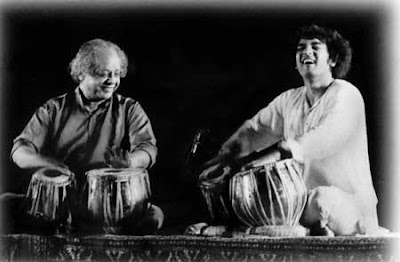
Ustad Allah Rakha & Zakir Hussain Tabla Solo Teental


Ravi Shankar, Alla Rakha - Tabla Solo in Jhaptal

Monday, November 29, 2010

Vijay Ghate

Vijay Ghate


Vijay Ghate, originally from Jabalpur, has been recognized by all musicians and dancers alike as the most brilliant and exciting among tabla players of the present generation.

Vijay started learning his art at a very early age of three in Jabalpur.He then moved to Mumbai, and for over twelve years he put himself under the tutelage of Pandit Suresh Talwalkar. Even at the age of 16 he became well-known for his scintillating solo performances.He is one of the few rare tabla players who is adept and comfortable accompanying all the three streams of Vocal, Instrumental and Dance. Quickfire anticipation fulled with a very creative mind and imagination, clarity in playing, dextirity, accuracy are his forte.

He has been accompanying many well known artistes like Ustad Vilayat Khan, Pandit Hariprasad Chaurasia, Ustad Amjad Ali Khan, Pandit Shiv Kumar Sharma, Pandit Birju Maharaj, Pandit Jasraj, Ustad Shahid Parvez, Pandit Vishwa Mohan Bhat and many others all over the world. He has been very well acknowledged for his forays into fusion in world of music with well known artistes from the western world like famous group Jethrotul and great maestros in easy Jazz like George Dukes, Aljereu, Ravi Coltarin, and also frequently working with Egberto Gismonti, Larry Coryell, George Brooks, etc.He has also collaborated with well known Indian musicians in this field like Louis Banks, Shankar Mahadevan, Shivmani etc.

Wednesday, November 24, 2010

Pandit Chatur Lal

Pandit Chatur Lal

14th Oct, 1965, India lost a great Tabla Wizard with the untimely death of Pandit Chatur Lal at the young age of 40. The violinist virtuoso, Late Lord Yehudi Menuhin, once remarked "Pandit Chatur Lal was one of those few supreme pioneer musicians who won for India the great and growing following it now commands in the West. He stole the hearts of his audiences wherever he went with his art and his enchanting personality".

Pandit Chatur Lal himself observed, "All My Efforts Served A Single Purpose: Sangat Both In Art And Life."

Pandit Chatur Lal was the first Indian percussionist to take Indian drums ‘Tabla’ to the West in 1955 with Usatd Ali Akbar Khan then in 1956-57 with Pandit Ravi Shankar and so on.

He was also the first Indian musician who’s tabla solo LP was released both in the East & the West. A German disciple then the Director of Max Muller Bhawan, Dr. Heimo Rau, called him 'the incarnation of the god of music' who opened to the listener a fourth dimension of experience beyond time and space.

Born on April 16, 1926 in Uadipur, Rajasthan. While yet a boy, Chatur Lal started a vigorous period of long and continues practice, which is the only way to attain perfection. Night after night Chatur Lal's drum-beating became a source of nuisance for the local policeman in the night duty. One day the policeman lost his patience and knocked at the door and burst upon him: "You should be in bed at this time. You have no business to keep the locality awake." A little frightened but undaunted, the little boy went on playing the Tabla every night, except when it was the time for the policemen to pass their house.

In 1947, Chatur Lal came to Delhi and joined All India Radio. Since 1948, he regularly participated in programmes and conferences all over the India and Abroad. He played with masters like to name few Baba Allaudin Khan, Pandit Onkarnath Thankur, Pt. Ravi Shakar, Pandit, Ustad Ali Akbar Khan, Ustad Vilayat Khan, Pt. Nikhil Banerjee and many others.

In 1952, he went to Afghanistan with Pandit Omkarnath Thakur and in 1955, he visited Britain and United States on the invitation of Museum Of Modern Art and OMNIBUS, the Rockefeller Ford Foundation TV Workshop in performances with Sarod Maestro, Usatd Ali Akbar Khan. In 1956-57, he toured to North America and Europe with one of the greatest sitar maestro Pandit Ravi Shankar and in 1960 he visited the Soviet Union and Mongolia with Indian delegations. In 1961, he went on a World tour with Mrs. Sharan Rani.

His Second tour included the first ever fusion concert between the East & the West where Chatur Lal representing his Indian drums 'Tabla' and greatest drummer Sir Philly Joe Jones representing his Western drums.

His last trip was in 1964 in association with Max Muller Bhawan, he organized a concert for his younger brother , Pt. Ram Narayan to West Germany which included 25 cities. Dr. Heimo Rau commented, "In India and Germany will never forget him since for them he opened that gate to the Indian music." This trip also took two brothers to France and Britain.

Commenting on the performances of Chatur lal, The famous German Newspaper, Frankfurter Rundschan, said "Our little drums are stuck with sticks. However virtuoso they may be, yet compared to the art of the Indian Tabla player, Chatur lal they sound barbarian. His playing sometimes sound like rhythmically arranged drops of rain, sometimes the finger flew over the membranes like a family of salamanders."

Chatur lal developed a style of his own, noted for a lightning rhythmic pattern and an intimate understanding of the mood of the artiste he accompanied "his style", Mr. Lothar Lutze of Max Muller Bhawan said, "amalgamated" many different elements, among them south Indians ones, and with the artiste on his standing, became a personality – bound pure style. He always showed an uncanny adroitness and skill in his accompaniment, while his solo was notable for case, clarity, diversity and grace where that were all his own.

On the occasion of the Paluskar Musical Festival in Delhi in 1960, the music critic of the Statesman aptly commented on the style of the great percussionist "After the interval Chatur lal gave a fine Tabla recital." Playing with great skills and finesse and weaving his percussion sonorities into every conceivable caprice of form of rhythm, he gave proof of his supreme command of the instrument. With perfect coordination between the two hands, the artiste played with tremendous zest and fervor passing at times into a mood of rhythmical abandon. It was a most impressive recital – forceful, fluent and almost unbelievably elemental in its rhythmic appeal.

The "Drums of India" and "Drums On Fire" are some of the important solo recordings of Pandit Chatur Lal in Hollywood's 'World Pacific Recordings'. He also composed and gave music for a short animated Canadian film 'A Chairy Tale', 'A Certain View', 'Now what my Little Man'. A French Television also made a short documentary film on him "Rythmes d'aillenres".