Search This Blog

Saturday, February 5, 2011

The lilting notes of friendship

Pandit Bhimsen Joshi’s fan following in Mumbai included some of the city’s wealthiest men and women. Hosting him in their grand homes was a dream project for many of them. But for the four decades that the legendary singer gave concerts in Mumbai, there was only one place he would stay—the Worli flat of his boyhood friend Narhari B H Kulkarni, where he greatly enjoyed a rustic meal of jowari bhakri and bhaji.
The very ordinary businessman with eclectic tastes, seven years younger to Panditji, had known him through his ups and downs, his peak as well as his one bad patch. Kulkarni, after all had been there when, at age 20, the master singer had made his debut in their hometown, Hubli, with the blessings of his guru, the great Sawai Gandharva.
“He started singing at 7 pm and continued to sing till 6 am the next morning. He held each raga for two hours and did not once repeat a single taan, he was that creative even then,” recalls 82-year - old Kulkarni.
Fate brought the two friends together once again in Mumbai in 1946. A young singer looking for a break on radio, Panditji had moved to Mumbai to seek his fortune. He shared a one-room tenement in Matunga with 20 other struggling youngsters all from the Dharwad-Bijpaur-Karwar-Belgaum belt. All they could use that room was to bathe and sleep in.
The tram journey from Matunga to the AIR office at Charni Road cost an anna then and since the jobless singer could not afford it, he would walk the whole distance to try his luck at the radio station. Time and again he would be shooed off by the AIR bosses. But his persistence paid off and he began to be given occasional programmes. Each programme would fetch him Rs 5 and he would make it last for 15 days.
“He survived on kurmura (puffed rice) and shengdana (peanuts),” recollects Kulkarni. But Joshi’s incredible talent did not remain hidden for long; he became a regular on radio and started travelling extensively on concerts. He moved to Pune and built himself a home there. By the ’70s he had become one of the most loved and acclaimed figures on the Hindustani music scene.
“But he remained a humble and unpretentious man throughout,” says Kulkarni. “No ego, no politics, no desire for the trappings of fame. He was a spiritual man, a follower of Raghavendra Swami. And all that mattered to him was his music and his audience. You know he would go to any length to see a smile on the face of his listeners, even if it meant singing for an extra hour. He would sometimes break into a taan right here on my terrace and ask me: ‘How does that sound?’ He was the only singer I ever listened to actually.”
The only time the singer would get riled was when he had to deal with uninformed reviews, critics who could not even identify his music. Smiles Kulkarni, “He would publicly chide the critics by singing a raga and asking them: ‘So now tell me, what did I sing?’ ” The only man who remained totally unperturbed by the lack of official recognition, the delay in being awarded a Bharat Ratna and all such political issues connected to his life was the man himself.
Kulkarni would visit him once a month even after Joshi became bed-ridden some years ago. “The discussions always revolved around the family, our mutual friends,” he says. It was a friendship that lasted till the very end.

‘His music had an incomparable density’ - Pandit Jasraj

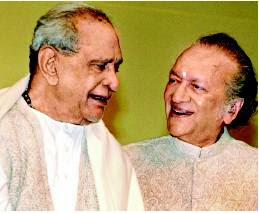
Pandit Bhimsen Joshi with Pandit Jasraj
His music had an incomparable density’ -Pandit Jasraj


The first time I heard him in 1942, I was electrified. He was singing Miyan ki Malhar, one of his favourites. His artistry was wondrous, like nothing I had encountered before. I found over the years that like really evolved musicians he stuck to a repertoire of only about a dozen ragas. But what he sang was deep, dense and stunning. His breath control, the strength of his singing-no other musician I know has that quality.

It was another 16 years before I heard him again-this was in Kolkata, where I lived then, in 1958. He sang Todi and left the audience gaspingthereafter, he was invited to practically every music conferences in Kolkata. Entire concert schedules were changed to get him into the programme.
I am always astonished at the ease and joy with which he sang abhangs (Marathi devotional songs). After all, he was a highly respected classical musician, a colossus. Yet he sang abhangs and even film songs with the same passion, force and love. Ketaki gulab juhi from Baiju Bawra which he sang with Manna Dey was such a brilliant song. He was what I call a chaumukha gayak—no facet of music was too light or unimportant for him to ignore.

He was an extremely affectionate man, simple and very good-natured. He was particularly encouraging of younger musicians. I remember a train journey from Kolkata to Mumbai in 1966. We were traveling together and out of the blue he turned around and told me: “When I look back at those who are following in my footsteps, I see only you.” For a young musician it was an overwhelming pat on the back.

I met him the last time in December last year. I had sung at the Sawai Gandharva Festival he hosts in Pune and went to meet him the next morning to pay my regards. “You did well last night,” he said. I asked for and got his blessings. Then he said: “I am tired, I want to sleep.”
I believe that he was the only classical musician to have recognition across the country. When he turned 60, I was asked to pay him a tribute. I remember what I said: Tansen had Akbar to back him, but Pandit Bhimsen Joshi has crores of Indians behind him. Listen to him sing Mile sur mera tumhara and you get the sense that the south, the east, the west and the north are all bound by one reverberant voice.


Pt Bhimsen Joshi & Jasraj - Malkauns


Pandit Bhimsen joshi - Jai Durge

Pandit Bhimsen Joshi - A DIVINE VOICE IS STILLED

A DIVINE VOICE IS STILLED
He was a colossus among musicians, loved for his humility and simplicity as much as his mesmeric voice and talent. In a career spanning over six decades, he took the Kirana gharana and Hindustani music to a new high and earned fans among connoisseurs and ordinary folk alike. TOI pays tribute to Bharat Ratna Pt Bhimsen Joshi

One of the most beloved and versatile musicians of our times has sung his last note. Bhimsen Joshi passed away in Pune on Monday after struggling with a brief illness. He was 88 years old. He was one of those rare artistes who enjoyed both popularity and stature.

The maverick Joshi, known for living a colourful, even somewhat reckless, life, was a musical explorer even as a child. He was raised in Dharwad district of Karnataka, the eldest of many siblings. His grandfather was a kirtan singer and his father a Sanskrit scholar and school headmaster. To the dismay of his parents, young Joshi was often found standing for hours outside a record shop on the path between his school and his home, listening to classical and devotional music. The defining moment of his life came around the age of 12, when he heard a record of Abdul Kareem Khan’s Raga Basant, decided he wanted to sing like that, and left home in search of a guru. He travelled on his own as far as Delhi and Kolkata, even wandering ticketless sometimes. His father managed to track him down three years later in Jallander. That was when he was directed to Sawai Gandharva, a maestro of the Kirana gharana, who lived close to his hometown.

Like many great musicians, Sawai Gandharva put his student through rigorous tests before imparting the secrets of his music. To begin with, he demanded a fee of Rs 25 per month. This was one-fourth of the senior Joshi’s salary, but he made the sacrifice just to keep his son closer to home. Sawai Gandharva made his student do all kinds of menial chores before he was convinced of his desire to learn. After that, his tutelage was morning, noon and night for about five years. The maestro taught him three ragas—Todi, Multani and Puriya. Joshi learnt other ragas when supporting his guru at concerts or from his fellow student, Gangubai Hangal.

It was Begum Akhtar who recommended Joshi for his first job as a musician—with All India Radio, Lucknow. In 1943, he took a transfer to Bombay, then the music capital of the country. He shot to fame after a series of HMV recordings and, notably, after a performance at the 60th birthday celebrations of Sawai Gandharva, held in Pune.
His popularity spread steadily thereafter, and within a decade, he became the busiest vocalist on the concert circuit. By the 1960s, Bhimsen Joshi's contemporaries had begun to joke, with some envy, that he knew every air hostess on Indian Airlines by name, and the entire Bradshaw (Indian Railways time-table) by heart!

Joshi was awarded the Bharat Ratna in 2009, after receiving the Padmashri in 1972, the Padma Bhushan in 1985 and the Padma Vibhushan in 1999. Apart from classical music, he was known for his devotional music, especially his evocative Marathi abhangs. Joshi also sang for films in numerous languages including Hindi (Basant Bahar and Bhairavi), Bengali (Tansen) and Marathi (Gulacha Ganapati ). He became a national icon after his memorable Mile sur mera tumhara, a song to celebrate national integration.

As vocalist and his deep admirer Ashwini Bhide-Deshpande says, “He has enjoyed adulation and affection from all people—he belongs to not just the Kirana gharana, he belongs to everybody. You can ask a rickshaw driver or a coolie and they would have heard of him. He was equally comfortable in a big music conference in Kolkata as he was in a small town in Karnataka. All that mattered to him was his raga, his music.”

The young Jayateerth Mevundi, who has often been described as a young likeness of Bhimsen Joshi, says, “I used to literally worship him. His blessings have been with me always. He actually called me to the Sawai Gandharva festival when I was 23 years old and tuned my tanpura for me. He has been very kind to me. What I love about him is that he dedicated his entire life to music without any worldly considerations or expectations. He is like a Gandharva.”
And that is the sentiment that thousands of music-lovers share about the great and astonishingly simple musician for whom, in the end, it was only the tuneful pukaar of “Vithal, Vithal, Vithal…” that mattered.


andit Bhimsen Joshi with his Father

Pandit Bhimsen Joshi with his Father

Pandit Bhimsen Joshi with Former President Dr, APJ Adbul Kalam

Pandit Bhimsen Joshi with Former President Dr, APJ Adbul Kalam


Pandit Bhimsen Joshi with Pandit Shivkumar Sharma

Pandit Bhimsen Joshi with Pandit Shivkumar Sharma

Pandit Bhimsen Joshi with Lata Mangeshkar

Pandit Bhimsen Joshi with Lata Mangeshkar


Pandit Joshi With Ustad  Zakir Hussian

Pandit Joshi With Ustad Zakir Hussian

Pandit Bhimsen Joshi with Pandit Ravishanker

Pandit Bhimsen Joshi with Pandit Ravishanker

Bhimsen Joshi - A DIVINE VOICE IS STILLED

A DIVINE VOICE IS STILLED
He was a colossus among musicians, loved for his humility and simplicity as much as his mesmeric voice and talent. In a career spanning over six decades, he took the Kirana gharana and Hindustani music to a new high and earned fans among connoisseurs and ordinary folk alike. TOI pays tribute to Bharat Ratna Pt Bhimsen Joshi


One of the most beloved and versatile musicians of our times has sung his last note. Bhimsen Joshi passed away in Pune on Monday after struggling with a brief illness. He was 88 years old. He was one of those rare artistes who enjoyed both popularity and stature.

The maverick Joshi, known for living a colourful, even somewhat reckless, life, was a musical explorer even as a child. He was raised in Dharwad district of Karnataka, the eldest of many siblings. His grandfather was a kirtan singer and his father a Sanskrit scholar and school headmaster. To the dismay of his parents, young Joshi was often found standing for hours outside a record shop on the path between his school and his home, listening to classical and devotional music. The defining moment of his life came around the age of 12, when he heard a
record of Abdul Kareem Khan’s Raga Basant, decided he wanted to sing like that, and left home in search of a guru. He travelled on his own as far as Delhi and Kolkata, even wandering ticketless sometimes. His father managed to track him down three years later in Jallander. That was when he was directed to Sawai Gandharva, a maestro of the Kirana gharana, who lived close to his hometown.

Like many great musicians, Sawai Gandharva put his student through rigorous tests before imparting the secrets of his music. To begin with, he demanded a fee of Rs 25 per month. This was one-fourth of the senior Joshi’s salary, but he made the sacrifice just to keep his son closer to home. Sawai Gandharva made his student do all kinds of menial chores before he was convinced of his desire to learn. After that, his tutelage was morning, noon and night for about five years. The maestro taught him three ragas—Todi, Multani and Puriya. Joshi learnt other ragas when supporting his guru at concerts or from his fellow student, Gangubai Hangal.
It was Begum Akhtar who recommended Joshi for his first job as a musician—with All India Radio, Lucknow. In 1943, he took a transfer to Bombay, then the music capital of the country. He shot to fame after a series of HMV recordings and, notably, after a performance at the 60th birthday celebrations of Sawai Gandharva, held in Pune.

His popularity spread steadily thereafter, and within a decade, he became the busiest vocalist on the concert circuit. By the 1960s, Bhimsen Joshi's contemporaries had begun to joke, with some envy, that he knew every air hostess on Indian Airlines by name, and the entire Bradshaw (Indian Railways time-table) by heart!

Joshi was awarded the Bharat Ratna in 2009, after receiving the Padmashri in 1972, the Padma Bhushan in 1985 and the Padma Vibhushan in 1999. Apart from classical music, he was known for his devotional music, especially his evocative Marathi abhangs. Joshi also sang for films in numerous languages including Hindi (Basant Bahar and Bhairavi), Bengali (Tansen) and Marathi (Gulacha Ganapati ). He became a national icon after his memorable Mile sur mera tumhara, a song to celebrate national integration.

As vocalist and his deep admirer Ashwini Bhide-Deshpande says, “He has enjoyed adulation and affection from all people—he belongs to not just the Kirana gharana, he belongs to everybody. You can ask a rickshaw driver or a coolie and they would have heard of him. He was equally comfortable in a big music conference in Kolkata as he was in a small town in Karnataka. All that mattered to him was his raga, his music.”

The young Jayateerth Mevundi, who has often been described as a young likeness of Bhimsen Joshi, says, “I used to literally worship him. His blessings have been with me always. He actually called me to the Sawai Gandharva festival when I was 23 years old and tuned my tanpura for me. He has been very kind to me. What I love about him is that he dedicated his entire life to music without any worldly considerations or expectations. He is like a Gandharva.”
And that is the sentiment that thousands of music-lovers share about the great and astonishingly simple musician for whom, in the end, it was only the tuneful pukaar of “Vithal, Vithal, Vithal…” that mattered.


Mile Sur Mera Tumhar

Sunday, January 23, 2011

Bharat Ratna Bhimsen Joshi dies in Pune


Legendary vocalist Pandit Bhimsen Joshi, who enthralled generations of connoisseurs with his renditions of Hindustani classical music, passed away at a city hospital today after a prolonged illness.

He was 89.

A recipient of Bharat Ratna, the highest civilian award, Pandit Bhimsen Joshi had been put on life support system following old age-related ailments leading to kidney and respiratory failure after his admission to hospital on December 31, his family said.

Pandit Bhimsen Joshi, the most-celebrated exponent of 'Kirana gharana' of Khansahib Abdul Karim Khan, leaves behind three sons and a daughter.

A pall of gloom descended on the city as the news of his demise spread with people making a beeline to his residence to pay their last respects to the singer who was the most powerful figure on the Hindustani music concert platform of 'khayal gayki'. Born on February 4, 1922 at Gadag in Dharwad district of Karnataka, Pandit Bhimsen Joshi got a boost to his career during a concert in Pune in January 1946 on the occasion of the 60th birthday of his guru Sawai Gandharva.

What distinguished him from the ordinary was his powerful voice, amazing breath control, fine musical sensibility and unwavering grasp of the fundamentals that made him the supreme Hindustani vocalist, representing a subtle fusion of intelligence and passion that imparted life and excitement to his music.

In the forays he made outside the classical fold, Pandit Bhimsen Joshi lent is voice as a "dhrupad" singer for a Bengali film based on the life of Tansen and later sang as a playback singer for Marathi film Gulacha Ganapati, produced and directed by celebrated Marathi humorist "Pu La" Deshpande in addition to Hindi movies Basant Bahar and Bhairavi.

But it was his 'Sant Vani' recitals, which bore the flair of Marathi 'Bhakti Sangeet' that added immensely to his popularity in both Maharashtra and Karnataka which have had a long succession of saint-poets.

He was honoured with the Padma Shri (1972), Sangeet Natak Akademi award for Hindustani vocal music (1975), Padma Bhushan (1985) and Madhya Pradesh government's "Tansen Samman" in 1992. Bharat Ratna was bestowed on him in 2008.

Pandit Bhimsen Joshi had undergone a surgery for removal of a brain tumor in 1999 followed by a cervical spine operation in 2005.

The maestro's last surprise public performance that regaled the audience was during 2007 'Sawai Gandharva' annual music festival which he himself had started to commemorate the memory of his guru. Pandit Bhimsen Joshi's body was taken to his residence where it would be kept for people to offer their last respects till this afternoon.

The final rites would be performed in the evening, family sources said.

Condoling the passing away of the maestro, President Pratibha Patil said, "In his death, the country has lost a greatest personality who was an exponent of vocal music."

CDS on Sale
PANDIT BHIMSEN JOSHI Golden Raaga Collection


BEST OF PANDIT BHIMSEN JOSHI: DEVOTIONAL SONGS


PANDIT BHIMSEN JOSHI Unsung Raaga Puriya

Pandit Bhimsen Joshi: A challenge unto himself

Pandit Bhimsen Joshi


Pandit Bhimsen Joshi’s life and music is marked by his wanderlust: nothing ever stopped him from soaring into realms unknown. The legendary musician was the last link of the golden years of Kirana, however, he will continue to live in hundreds of musicians across the country

It’s not possible to sum up a musical icon’s career. At best it’s possible to trace his life — from birth to death. Pandit Bhimsen Joshi (1922-2011), the “high commissioner of music”, as the legendary Kirana vocalist jokingly called himself, is no more. A study of his music can never be complete — this is not only because of the highly intuitive nature of the Indian music tradition, but also because of the kind of musical persona that Bhimsen Joshi was.

Deeply passionate about music, Bhimsen Joshi was always a wanderer; in life and in music. His parents were subject to moments of great anxiety when their little son would often go missing from home. It started when he was three; he would either be sitting in the mosque before his house trying to grasp the notes in the muezzin’s prayer Allah O’ Akbar, or he would be at some nearby temple listening to the temple musicians, there were times when he, as if he were in a trance, followed bhajan mandalis and wedding processions — completely tuned to musical notes and switched off to everything else. On several occasions, his father Gururaj Joshi lodged a complaint with the police, but often some Good Samaritan would bring the little boy back to his parents. At 11, Bhimsen Joshi left home over a flimsy reason: he quarreled with his mother because she could not afford to serve him ghee with rice. He had stomped out, leaving his food untouched.

Long journey to Kirana gharana

This was the turning point in his musical quest. After listening to the pioneer of Kirana gharana Ustad Abdul Karim Khan saab’s gramophone recording of raga Jhinjoti in a nearby tea shop, his heart was set on learning from him. He stood at the Gadag station and took a train that was heading towards North India. He was penniless, but had to reach his destination. He gave a slip to ticket collectors moving between compartments, sang songs for fellow passengers and begged for food. He stopped at Pune, Bombay and finally reached Gwalior after three months! He met and learnt from various maestros, but was unsatisfied.

In search of a guru

He went from Kharagpur to Calcutta to Delhi and finally to Jalandhar where the Gwalior maestro Vinayak Rao Patwardhan advised him to learn from Sawai Gandharv, in Kundagol, an outstanding disciple of Ustad Abdul Karim Khan. Though he shared an exceptional relationship with Sawai Gandharv, it however did not mark the end of his quest. He worked very hard to earn his music. In the sixties, when Bhimsen Joshi sang for the Calcutta Music Circle, the famous actor Pahadi Sanyal was present in the audience. Once the concert was over, Bhimsen Joshi went up to the actor and reminded him that he worked as a domestic help for him in the years that he was looking for a suitable guru, much to the actor’s embarrassment.

Bhimsen Joshi’s intense passion for music made him a non-conformist of sorts. While he stuck to the traditional, limited repertoire of the Kirana gharana, he was open to ideas from other gharanas as well. Unlike his guru bandhu Gangubai Hangal who never swayed away from the boundaries of the gharana, Bhimsen Joshi, to use his own term, “processed all the commodities in the Kirana factory”. A firm believer of the guru-shishya tradition, Bhimsen Joshi would say, “What one learns from one’s guru has to be supplemented by individual genius, else, one will not have anything worthwhile to say. In fact, a good disciple should not be a second rate imitation, but a first rate improvement of his teacher.” Hence, you find LPs in which Bhimsen Joshi sings ragas like Chaya Malhar which is a stamp of the Gwalior school. Also Lalit Bhatiyar and Marwa Shree. He never hid his deep admiration for the Jaipur maestros — Mallikarjun Mansur and Kesarbai Kerkar. In fact, once Kesarbai Kerkar who had high regard for Bhimsen Joshi’s music, came for his concert and later jocularly remarked, “I came to see what all you have stolen from me!” Musicologists believe that the sonorous tonal quality of Bhimsen Joshi’s opening note, the shadja, was strikingly similar to that of Kesarbai. He never disputed it.

The Bhimsen style

Bhimsen Joshi’s music is made of many shades – contemplative and mellow, intuitive and erratic. He took the traditional Kirana ragas to highest level of complexity. His brilliant virtuosity was always coupled with romantic intensity. But Bhimsen Joshi was constantly stretching the thresholds; a man of obsessive restlessness, he often dared to challenge his own music. There were moments in his music when he knew it would fail, but he nevertheless surrendered to the test. Both his imagination and execution went into relentless ramblings, but the fear of the unknown hardly deterred him from exploring higher realms. That’s probably why he is the only Kirana maestro to have even attempted a raga like Ramkali.

Bhimsen Joshi preserved the various streams of past and tradition within him, with great humility and respect. In doing so, he constantly broke established idioms and infused them with new ideas. In fact, he was rebuilding tradition and in the process never hesitated to bare himself.

Bhimsen Joshi is a living tradition. His maverick genius may be hard to replace, but it’s hard for a practicing musician of today to not come under the spell of his influence. When you listen to musicians from various gharanas across the country, you invariably hear Bhimsen Joshi in them. Just like Pandit Bhimsen Joshi kept alive in his music Ustad Karim Khan, Sawai Gandharv, Roshan Ara Begum and many others. He continues to live in his music.

Monday, January 3, 2011

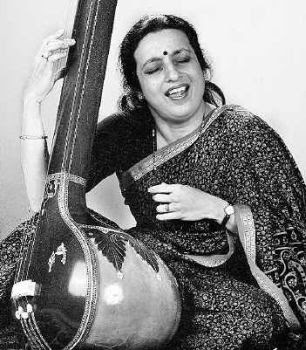
Ashwini Bhide Deshpande

Ashwini Bhide Deshpande


Dr. Ashwini Raja Bhide-Deshpande (born in October 10, 1960) is a Hindustani classical music vocalist of the Jaipur-Atrauli Gharana.


Early life and training

Born in Mumbai into a family with strong musical traditions, Dr. Bhide-Deshpande started her early classical training under the guidance of Narayanrao Datar. She then completed her Sangeet Visharad from the Gandharva Mahavidyalaya. Since then, Dr. Bhide-Deshpande has been under the tutelage of her mother Smt. Manik Bhide, who has been instilling in her the intricacies and traditions of the Jaipur-Atrauli Gharana. Ashwini has inherited all that was best in her mother's style
and was able to add a lot to her repertoire with great sensitivity and intellect. Dr. Bhide-Deshpande also received guidance from one of the stalwarts of the Jaipur-Atrauli Gharana, Pt. Ratnakar Pai until his death in 2009.

Education

Dr. Bhide-Deshpande holds a Masters degree in Microbiology and earned a doctorate in Biochemistry from the University of Bombay.

Performing career

It was not until she completed her doctorate, when Dr. Bhide-Deshpande even considered a professional career in music. Despite, Dr. Bhide-Deshpande was well-received by musical connoisseurs since her late teens. Since the late 1980s, Dr. Bhide-Deshpande has been on concert tours to every continent and frequently performs at prestigious music conferences around the world, including the Sawai Gandharva Sangeet Mahotsav in Pune, Maharashtra.

She has performed in a number of prestigious music conferences in India for over fifteen years and has had successful concert tours of Europe and North America.

Musical style

Because of her strong influences from the Jaipur-Atrauli Gharanas, Dr. Bhide-Deshpande, has created her own musical style that respects the vocal culture and presentation aesthetics of the Jaipur-Atrauli Gharana. She holds a strong command over the three primary saptaks.

Composer

Dr. Bhide-Deshpande has an intimate understanding of Bandish and bandish-composition and has created many of her own bandishes, which she has published in her book, Raag Rachananjali.


Ashwini Bhide is not only a music scholar but is also blessed with a beautiful voice. I have personally known Ashwini since her early teens and it makes me so happy to see her blossom into such a wonderful Khayal singer. She has earned the reputation of being one of the top young artists of India... Having learnt many old compositions, she has been able to retain the spirit of the tradition through the dialects she has used as well as pay attention to the subject matter!
— Pt. Ravi Shankar

Students

Ashwini Bhide is also a powerful teacher, as well as performer and has taught a handful of distinguished disciples like Saniya Kulkarni-Patankar, Revati Kamat, Shruti Ambekar, Saili Oak, Shivani Haldipur, Dhanashree Ghaisas, and Poorvi Tonpay.


Soulful diva: Ashwini Bhide Deshpande